
Colossi of Memnon in Luxor: Unveiling the Ancient Marvels
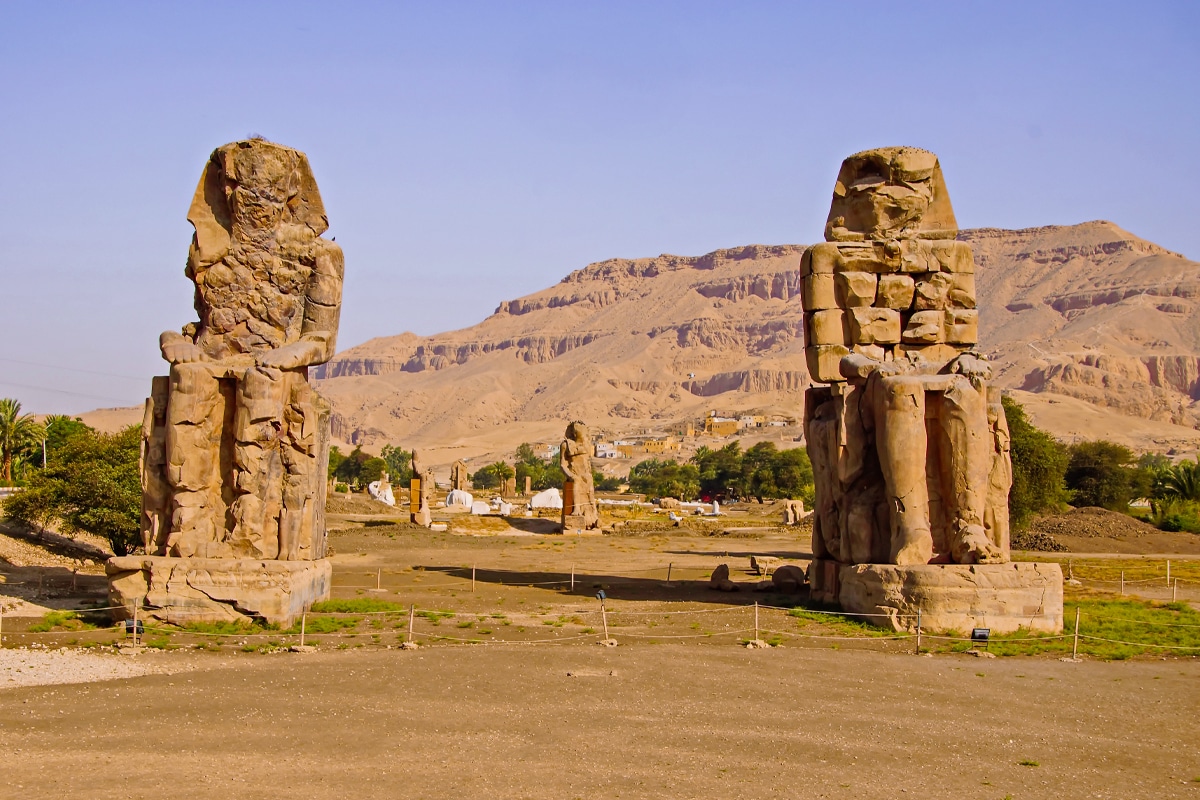
On the west bank of the Nile, across from the modern city of Luxor, two massive stone statues sit alone in a green field. They have been there for over 3,400 years. They have seen empires rise and fall. They have heard the prayers of pilgrims, the footsteps of Roman emperors, and the cameras of millions of tourists.
These are the Colossi of Memnon—two of the most famous statues in Egypt.
In this guide, we will tell you everything you need to know about these ancient marvels. You will learn:
- Who built them and why
- How they were constructed
- The strange “singing” legend
- What to see when you visit
- Why they still matter today
Where Are the Colossi of Memnon?
The Colossi of Memnon are located on the west bank of the Nile River, near the city of Luxor in Upper Egypt.
They stand in what was once the largest temple complex in Egypt—the mortuary temple of Pharaoh Amenhotep III. Today, almost nothing remains of that temple except these two statues. They rise about 18 meters (60 feet) tall from a stone base.
If you are visiting the Valley of the Kings or Hatshepsut’s Temple, you will pass right by them. They are impossible to miss.
Who Built the Colossi?
The statues were built for Pharaoh Amenhotep III, who ruled Egypt during the 18th Dynasty, around 1350 BC.
Amenhotep III was one of the wealthiest and most powerful pharaohs in Egyptian history. His reign was a time of peace, prosperity, and massive building projects. He built temples, palaces, and statues across Egypt.
The Colossi originally stood at the entrance of his mortuary temple—a huge complex called the “House of Millions of Years.” In its day, this temple was the largest and most lavish in Egypt, even bigger than Karnak.
Sadly, later pharaohs took stones from the temple for their own projects. Earthquakes and floods destroyed most of what remained. Today, only the Colossi survive as a hint of the original glory.
How Were They Built?
The Colossi of Memnon are carved from blocks of quartzite sandstone. This stone is extremely hard and was quarried from a site near modern Cairo, almost 700 kilometers away.
Transporting these massive blocks was an incredible feat. Each statue weighs an estimated 720 tons. They were moved on wooden sledges, pulled by hundreds of workers, and then floated on barges down the Nile.
Once on site, skilled artisans carved the stone into the shape of the pharaoh. Amenhotep III is shown seated on a throne, his hands resting on his knees. He wears the nemes headdress (the striped cloth worn by pharaohs) and a royal kilt.
On the sides of the throne, carvings show:
- The god Hapi, symbol of the Nile’s flood
- His wife, Queen Tiye, standing beside his leg
- His mother, Mutemwiya
The statues face east, toward the river and the rising sun. This was intentional—the pharaoh was meant to greet the sun god Ra each morning.
The “Singing” Statues: A Strange Legend
The Colossi of Memnon are famous for a legend that began over 2,000 years ago.
What Was the “Singing”?
In 27 BC, a powerful earthquake struck Luxor. The northern statue was cracked, and large pieces of stone shifted. After that, visitors began reporting a strange phenomenon.
At sunrise, the damaged statue would emit a high-pitched sound—like a note of music, a bell, or a human voice.
Why Did It Happen?
Modern scientists believe the sound was caused by heat and moisture. As the morning sun warmed the cracked stone, trapped air and moisture expanded and escaped through the fissures, creating a musical tone.
The ancient Greeks and Romans had a different explanation. They believed the sound was the voice of Memnon, a legendary hero of the Trojan War.
Who Was Memnon?
Memnon was a king of Ethiopia who fought in the Trojan War. In Greek mythology, he was the son of Eos, the goddess of the dawn. When Memnon was killed by Achilles, Eos wept for him every morning, causing the dew.
Greek and Roman visitors to Egypt connected the statues to this myth. They believed one of the statues represented Memnon, and the dawn sound was him calling out to his mother.
Famous Visitors
The “singing” became famous throughout the ancient world. Roman emperors, poets, and generals traveled to Luxor just to hear it.
Some left graffiti on the statue’s base—inscriptions recording that they had heard the voice. You can still see these inscriptions today, written in Greek and Latin.
The Silence Returns
In 199 AD, another earthquake damaged the statue further. After that, the singing stopped forever. Roman Emperor Septimius Severus ordered repairs to the statue, but the sound never returned.
Today, the Colossi are silent. But the legend lives on.
The Symbolism of the Statues
In ancient Egypt, statues like these were not just art. They were magical tools meant to serve the pharaoh in the afterlife.
Guardians of the Temple
The Colossi stood at the entrance to Amenhotep III’s mortuary temple. Their job was to:
- Protect the temple from evil forces
- Show the power of the pharaoh to all who approached
- Receive offerings and prayers on behalf of the king
Divine Connection
By facing east, the statues greeted the sun god Ra each morning. This connected Amenhotep III to the cycle of death and rebirth. Every sunrise was a reminder that the pharaoh, too, would rise again.
The Queen’s Role
On the side of each throne, a smaller figure of Queen Tiye stands beside the pharaoh’s leg. This was unusual—most statues showed the queen as tiny and insignificant. Here, she is nearly the same size as the king, showing her high status and importance.
What Happened to the Temple?
The mortuary temple of Amenhotep III was once the largest in Egypt. It covered an area larger than the Karnak Temple complex.
Inside, there were:
- Dozens of statues
- Massive columns
- Courtyards and halls
- A sacred lake
But later pharaohs, especially Ramses II, reused its stones for their own buildings. They found it easier to take existing blocks than to quarry new ones.
Over the centuries, the Nile flooded the area repeatedly. The water weakened the foundations. Earthquakes toppled the remaining structures.
By the time modern archaeologists arrived, almost nothing was left except the Colossi.
Recent Discoveries
In the last 20 years, archaeologists have made exciting discoveries at the site.
The Colossi of Memnon Project
A team of Egyptian and European archaeologists has been excavating the area since the 1990s. They have found:
- Hundreds of statues – Including many of the goddess Sekhmet, who was associated with war and healing.
- Massive stone blocks – Fallen from the temple’s walls and columns.
- A processional way – A paved road leading to the Nile.
- Foundation deposits – Offerings placed when the temple was built.
Reconstructing the Temple
Using these finds, archaeologists are slowly piecing together what the temple looked like. Some statues have been restored and placed back on their original bases.
The work continues today. Each year, new discoveries add to our understanding of Amenhotep III’s magnificent temple.
Visiting the Colossi of Memnon Today
What You Will See
When you visit the Colossi, you will see:
- The two massive statues, sitting side by side
- Carvings on the thrones, including Queen Tiye and the god Hapi
- Greek and Latin graffiti from ancient tourists
- The surrounding fields, where the temple once stood
Best Time to Visit
The Colossi are open to visitors year-round. The best time is:
- Early morning – The light is beautiful, and the statues face the rising sun.
- Late afternoon – The crowds are smaller, and the light is warm.
How Long to Stay
You do not need hours at the Colossi. Most visitors spend 15 to 30 minutes here. It is a quick stop, but an essential one.
What to Bring
- Camera – The statues are photogenic, especially in morning light.
- Water – Even a short visit can be hot.
- Hat and sunscreen – There is no shade.
Entrance Fee
The Colossi are free to visit. They are in an open field, not inside a ticketed site. However, there may be guards who expect a small tip.
Other Sites to Visit Nearby
The west bank of Luxor is filled with incredible ancient sites. Combine your visit to the Colossi with:
The Valley of the Kings
The burial place of pharaohs like Tutankhamun, Ramses II, and Seti I. About 15 minutes from the Colossi.
Hatshepsut’s Temple
The stunning mortuary temple of Egypt’s most famous female pharaoh. Carved into the cliffs at Deir el-Bahari.
Medinet Habu
The mortuary temple of Ramses III. One of the best-preserved temples in Egypt, with colorful carvings and massive walls.
The Ramesseum
The mortuary temple of Ramses II. Once home to a massive fallen statue of the pharaoh, which inspired the poet Shelley’s “Ozymandias.”
Deir el-Medina
The village where the tomb builders lived. Their homes, tombs, and tools give us an intimate look at daily life in ancient Egypt.
Why the Colossi Still Matter
The Colossi of Memnon are not the biggest or best-preserved monuments in Egypt. But they are special.
A Link to the Past
They connect us directly to the people of ancient times. Greeks, Romans, and Egyptians all stood where we stand. They wondered at the same statues, heard the same legends, and felt the same awe.
A Reminder of What Was Lost
The Colossi remind us that time destroys even the greatest works of humans. Amenhotep III’s temple was once the largest in Egypt. Today, almost nothing remains. Only the statues endure.
A Symbol of Resilience
For 3,400 years, these statues have faced earthquakes, floods, and vandals. They have been damaged and repaired. But they still stand. They are a testament to the skill of ancient builders and the enduring power of human creativity.
Tips for Photographers
The Colossi are a favorite subject for photographers. Here are some tips:
- Golden hour – Shoot at sunrise or sunset for the best light.
- Get low – Kneel down and shoot upward to make the statues look even more massive.
- Include people – A person standing beside the statues shows their scale.
- Look for details – Zoom in on the carvings and graffiti.
- Go wide – Use a wide-angle lens to capture both statues together.
Common Questions About the Colossi of Memnon
Are the Colossi of Memnon the originals?
Yes. These are the original statues from Amenhotep III’s temple. They have been repaired over the centuries but are mostly original stone.
Why are they called “Memnon”?
Greek visitors named them after the Trojan War hero Memnon. The Egyptians called them by different names, but the Greek name stuck.
Can you go inside the statues?
No. The statues are solid stone. There are no interior chambers.
Are there more statues like this?
Yes. There were once many seated statues of pharaohs in Egypt. The Colossi of Memnon are the most famous, but similar statues exist at Abu Simbel and elsewhere.
Frequently Asked Questions
Where are the Colossi of Memnon located?
The Colossi are on the west bank of the Nile in Luxor, Egypt, near the Valley of the Kings.
Who built the Colossi of Memnon?
They were built for Pharaoh Amenhotep III around 1350 BC to guard his mortuary temple.
Why did the Colossi of Memnon sing?
An earthquake in 27 BC cracked one statue. Morning heat caused trapped air and moisture to escape, creating a musical sound. The phenomenon stopped after repairs in 199 AD.
Can you visit the Colossi of Memnon for free?
Yes. The statues are in an open field with no entrance fee, though a small tip for guards is appreciated.
How old are the Colossi of Memnon?
They were built around 1350 BC, making them over 3,400 years old.
Conclusion
The Colossi of Memnon may not be as famous as the pyramids or the Valley of the Kings. But they deserve your attention.
They are a monument to a great pharaoh, a testament to ancient engineering, and the source of one of history’s strangest legends. They have inspired poets, emperors, and travelers for thousands of years.
When you visit Luxor, take a moment to stop at these silent giants. Stand in their shadow. Imagine the sound that once greeted the dawn. And remember that you are standing in a place where ancient and modern worlds meet.
Check Our Top Nile Cruise Trips:-
Plan your visit to Luxor with Top Nile Cruises and experience the wonders of ancient Egypt for yourself.