
Exploring Karnak Temple: Unveiling Egypt’s Glorious Past
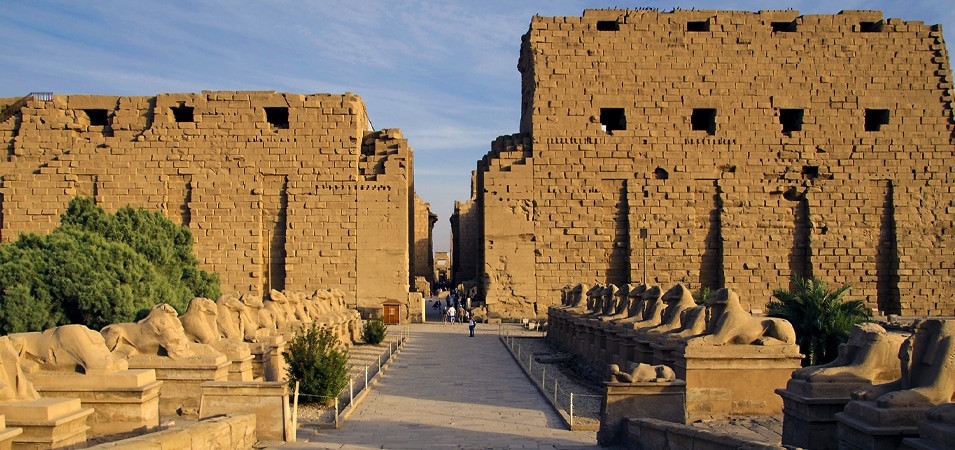
In the heart of Luxor, on the east bank of the Nile, lies a place that defies description.
It is not just a temple. It is a city of temples. A sacred landscape built, added to, and modified over 2,000 years. Every major pharaoh of the New Kingdom left their mark here. The result is overwhelming—a forest of towering columns, a maze of courtyards, and a collection of obelisks, statues, and reliefs that document the peak of ancient Egyptian civilization.
This is Karnak Temple.
More than any other site in Egypt, Karnak shows you the ambition, the devotion, and the sheer power of the pharaohs. It was the main cult center of Amun-Ra, the king of the gods, and it was the religious heart of the nation for millennia.
In this guide, we will take you through the history, architecture, and mysteries of Karnak. We will explore its most famous features—the Great Hypostyle Hall, the sacred lake, the obelisks—and give you practical tips for visiting.
Where Is Karnak Temple?
Karnak Temple is located in Luxor, about 2.5 kilometers north of the Luxor Temple. The two temples were once connected by the Avenue of Sphinxes, a 3-kilometer road lined with ram-headed sphinxes. This avenue has been partially restored and is now open to visitors.
The temple complex is enormous. It covers over 100 hectares (250 acres)—enough to hold about 10 cathedrals. It is not one temple but a collection of temples, chapels, pylons, and other structures, enclosed by a massive mud-brick wall.
A Brief History of Karnak
The Origins
The site was sacred long before the first stone temple was built. The earliest structures date to the Middle Kingdom (around 2000 BCE), but it was in the New Kingdom (1550–1070 BCE) that Karnak became truly monumental.
The New Kingdom Boom
Every major pharaoh of the 18th, 19th, and 20th Dynasties added something.
- Thutmose I built the first pylons and obelisks.
- Hatshepsut erected two massive obelisks (one still stands).
- Thutmose III added the “Festival Hall” and recorded his military campaigns.
- Seti I and Ramses II built the Great Hypostyle Hall.
- Ramses III added his own temple within the complex.
Later rulers, including the Nubian pharaohs and the Ptolemies, continued to add and restore.
Decline and Rediscovery
After the New Kingdom, Karnak’s importance declined. The rise of Christianity led to the closure of pagan temples. Some parts were used as churches. Over the centuries, the desert sands buried much of the complex.
European travelers and explorers “rediscovered” Karnak in the 19th century. Excavations have continued ever since, revealing more of its secrets.
The Precinct of Amun-Ra
Karnak is divided into several precincts, each dedicated to a different god. The largest and most important is the Precinct of Amun-Ra. This is where most visitors focus their attention.
The Avenue of Sphinxes
The approach to the temple is lined with ram-headed sphinxes. Each sphinx guards a statue of the pharaoh between its paws. This avenue originally stretched all the way to Luxor Temple.
The First Pylon
You enter through the First Pylon, a massive unfinished gateway. It is 113 meters wide and 43 meters high—one of the largest pylons in Egypt. It was never completed, and you can still see the mud-brick ramps used during construction.
The Great Court
Beyond the pylon lies a large open court. To your left, you will see:
- The Temple of Ramses III, a small but well-preserved structure.
- A statue of Ramses II (much of it is a copy; the original is in Cairo).
The Second Pylon and the Great Hypostyle Hall
Pass through the Second Pylon, and you enter the Great Hypostyle Hall—one of the most awe-inspiring spaces ever built.
The hall covers 5,000 square meters. It contains 134 massive columns, arranged in 16 rows. The central columns are 21 meters (69 feet) high, with capitals large enough to stand on. The side columns are slightly shorter.
The columns were once brightly painted. Traces of red, blue, and green are still visible. The stone “roof” is gone, so the hall is open to the sky, but the effect is still overwhelming.
The walls and columns are covered with reliefs. Look for scenes of Seti I and Ramses II making offerings to the gods. On the outer walls, you can see military scenes, including Ramses II’s famous battle at Kadesh.
Obelisks
Beyond the Hypostyle Hall, you will find the remains of several obelisks.
The tallest standing obelisk at Karnak belongs to Hatshepsut. It is 29 meters (97 feet) high and made of red granite. It was originally covered in electrum (a gold-silver alloy) to catch the sun.
Hatshepsut’s other obelisk lies fallen nearby. You can see where it broke.
The Sacred Lake
Every major temple had a sacred lake. Karnak’s is huge—about 120 meters by 80 meters. Priests used it for purification rituals. It may also have been used for festivals, with boats carrying statues of the gods.
You can walk around the lake. The view back toward the temple is beautiful.
The Festival Hall of Thutmose III
Behind the main temple, you will find a unique structure: the Festival Hall of Thutmose III. It is unlike any other building in Egypt, with pillars that resemble tent poles. It may have been built to celebrate the king’s jubilee (a renewal of kingship).
The Cachette Court
In this area, archaeologists found a massive cache of statues—over 800 stone statues and 17,000 bronzes. They had been buried by priests, likely to clear the temple of older statues. Many are now in museums.
Other Precincts at Karnak
The Precinct of Mut
Mut was the wife of Amun-Ra. Her temple complex is south of the main enclosure. It is less visited but worth seeing. It includes a sacred lake shaped like a crescent moon.
The Precinct of Montu
Montu was a war god, depicted with a falcon head. His temple is north of the main enclosure. It is mostly in ruins.
The Temple of Khonsu
Khonsu was the moon god, son of Amun and Mut. His small but well-preserved temple is near the southwest corner of the Amun precinct. It dates mainly to the Ramesside period.
The Sound and Light Show
At night, Karnak comes alive in a different way. The Sound and Light Show tells the story of the temple and the pharaohs who built it.
The show lasts about an hour. As you walk through the temple, different areas are illuminated. The narration weaves history and legend.
Tips for the show:
- Book in advance.
- Bring a jacket—evenings can be cool.
- The show is available in multiple languages.
Karnak’s Place in Egyptian Religion
Karnak was the earthly home of Amun-Ra, the king of the gods.
Amun means “the hidden one.” He was originally a local god of Thebes. As Thebes rose to prominence, so did Amun. He was merged with the sun god Ra to become Amun-Ra, the supreme deity.
Amun’s wife was Mut, and their son was Khonsu, the moon god. Together, they formed the Theban Triad—the divine family of Thebes.
The most important festival at Karnak was the Opet Festival. Each year, statues of the Theban Triad were carried in procession from Karnak to Luxor Temple. The journey celebrated the renewal of the pharaoh’s divine power.
What to See: A Checklist
With so much to see, it helps to have a plan. Here are the highlights:
- The First Pylon
- The Great Court and Temple of Ramses III
- The Great Hypostyle Hall
- Hatshepsut’s Obelisk
- The Sacred Lake
- The Festival Hall of Thutmose III
- The Cachette Court
- The Temple of Khonsu
Visiting Karnak Temple
How to Get There
Karnak is on the east bank of Luxor, about a 10-minute drive from the city center.
- By taxi: 20–50 EGP.
- By foot: If you are staying on the east bank, it is a long but possible walk.
- By tour: Most Luxor tours include Karnak.
Best Time to Visit
- Morning (8:00–11:00 AM): Cooler, good light, fewer crowds.
- Late afternoon: Beautiful light, but more crowded.
- Evening: For the Sound and Light Show.
How Long to Spend
At least 3 hours. You could easily spend half a day.
Tips for Your Visit
- Go early. It gets hot and crowded.
- Wear comfortable shoes. You will walk several kilometers.
- Bring water. There are vendors, but it is cheaper to bring your own.
- Hire a guide. The stories behind the reliefs bring the temple to life.
- Take your time. Sit in the Hypostyle Hall. Look up. Let it sink in.
Photography at Karnak
Karnak is a photographer’s dream.
Best spots:
- The Hypostyle Hall, with light streaming through the columns
- Hatshepsut’s Obelisk against the sky
- The Sacred Lake, with the temple reflected
- The Avenue of Sphinxes
Tips:
- Morning light is best for the Hypostyle Hall.
- A wide-angle lens is useful.
- Tripods may require a permit.
Karnak in Popular Culture
Karnak has appeared in:
- Films – Including Death on the Nile (both versions)
- Documentaries – Countless programs on ancient Egypt
- Video games – Assassin’s Creed: Origins features a detailed recreation
- Literature – Mentioned in many travel memoirs and histories
Its image—towering columns, fallen stones, eternal grandeur—has become synonymous with ancient Egypt.
Preservation and the Future
Karnak faces challenges:
- Weathering from wind and occasional rain
- Groundwater rising from the Nile and irrigation
- Tourist traffic – millions of visitors over time
The Egyptian government, working with international teams, continues to:
- Excavate and document the site
- Restore and stabilize structures
- Improve the visitor experience
Recent discoveries include the restoration of the Avenue of Sphinxes, which now connects Karnak to Luxor Temple.
Why Karnak Matters
Karnak is not just a collection of old buildings. It is a record of ancient Egypt’s rise, peak, and decline. It shows us how the pharaohs saw themselves—as builders, as warriors, as servants of the gods.
It is also a place of beauty. The Hypostyle Hall, with its forest of columns, is one of the most moving spaces on earth. Stand there, and you understand why the Egyptians built so large: to inspire awe, to connect heaven and earth, to last forever.
Frequently Asked Questions
Where is Karnak Temple located?
Karnak Temple is located in Luxor, Egypt, on the east bank of the Nile River, about 2.5 kilometers north of Luxor Temple.
How old is Karnak Temple?
Construction began around 2000 BCE during the Middle Kingdom and continued for over 2,000 years.
What is the Great Hypostyle Hall?
A massive hall with 134 columns, built by Seti I and Ramses II. It is one of the most famous structures in Egypt.
How long does it take to visit Karnak Temple?
Most visitors spend 2 to 3 hours exploring the main areas. History enthusiasts could spend half a day.
Conclusion
Karnak Temple is overwhelming. It is too big, too old, too much. But that is the point.
The pharaohs wanted to impress. They wanted to show their power and their devotion. And they succeeded. Three thousand years later, we still stand in their halls and marvel.
When you visit, take your time. Look at the details. Read the stories. Imagine the priests, the processions, the rituals. And then look up at the columns, and feel small—in the best way.
Check Our Top Nile Cruise Trips:-
Plan your visit to Karnak Temple with Top Nile Cruises and walk through the greatest temple ever built.