
Dendera Temple: Hathor’s sacred home
North of Luxor, on the west bank of the Nile, lies one of Egypt’s best‑preserved and most beautiful temples: the Temple of Dendera.
Unlike many Egyptian temples that stand in dusty, open plains, Dendera feels intimate. Its walls are still colored. Its ceilings are dark with soot from ancient fires. And in one small chapel, there is a carving that has sparked one of the strangest theories in Egyptology—the so‑called “Dendera light bulb.”
Dendera is dedicated to Hathor, the goddess of love, music, and joy. She was one of ancient Egypt’s most beloved deities, and her temple reflects that warmth. It is a place of celebration, not gloom.
In this guide, we will explore the history, architecture, mysteries, and practicalities of visiting Dendera Temple. Whether you are a first‑time visitor or a returning traveler, this temple will stay with you.
Where Is Dendera Temple?
The Dendera Temple complex is located near the town of Qena, about 60 kilometers (37 miles) north of Luxor. It sits on the west bank of the Nile, overlooking green fields and the desert beyond.
The site is easily reached by road from Luxor. Most visitors come on a day trip, often combining Dendera with the nearby Temple of Abydos.
A Brief History of Dendera
Ancient Origins
The name “Dendera” comes from the ancient Egyptian Iunet or Tantere. The site was sacred long before the current temple was built.
Archaeological evidence shows that a temple stood here as early as the Old Kingdom (around 2600 BCE). Pharaohs of the 6th Dynasty, including Pepi I, left inscriptions. Later rulers, including Thutmose III and Amenhotep III of the 18th Dynasty, also built here.
But most of what you see today dates from a much later period.
The Ptolemaic and Roman Eras
The current temple was built mainly during the Ptolemaic period (305–30 BCE) and added to by Roman emperors.
The Ptolemies were Greek, but they adopted Egyptian religion and built temples in the traditional Egyptian style. At Dendera, they created one of the finest examples of this fusion.
Construction began under Ptolemy VIII around 140 BCE and continued for nearly 200 years. Roman emperors, including Tiberius, Nero, and Domitian, added reliefs and inscriptions.
A Living Temple
Dendera was not just a monument. It was a living religious center for centuries. Priests and priestesses served Hathor here, performing daily rituals and celebrating festivals.
Even after the decline of ancient Egyptian religion, the temple continued to be used. In the Coptic (Christian) period, some rooms were adapted as churches. You can still see carved crosses on some walls.
Who Was Hathor?
To understand Dendera, you must understand Hathor.
Hathor was one of the most important and complex goddesses in the Egyptian pantheon. She was:
- The goddess of love, beauty, music, and dance
- The protector of women and childbirth
- The goddess of joy, celebration, and foreign lands
- Often shown as a cow or as a woman with cow’s horns and a sun disk
- Called the “Eye of Ra” and linked to the sun god
Hathor was also a funerary goddess. She welcomed the dead into the afterlife and offered them food and drink.
Her temple at Dendera was her main cult center. Pilgrims came here to pray for love, fertility, healing, and happiness.
The Architecture of Dendera Temple
Dendera is not a single building. It is a complex of temples, chapels, and other structures, surrounded by a mud‑brick enclosure wall.
The Main Temple of Hathor
The main temple is the largest and most impressive structure. It is built of sandstone and oriented toward the Nile.
The Facade: The entrance is through a massive pylon (gateway), though the pylon at Dendera is not as large as those at Karnak or Edfu. Above the door, you see a winged sun disk—a symbol of protection.
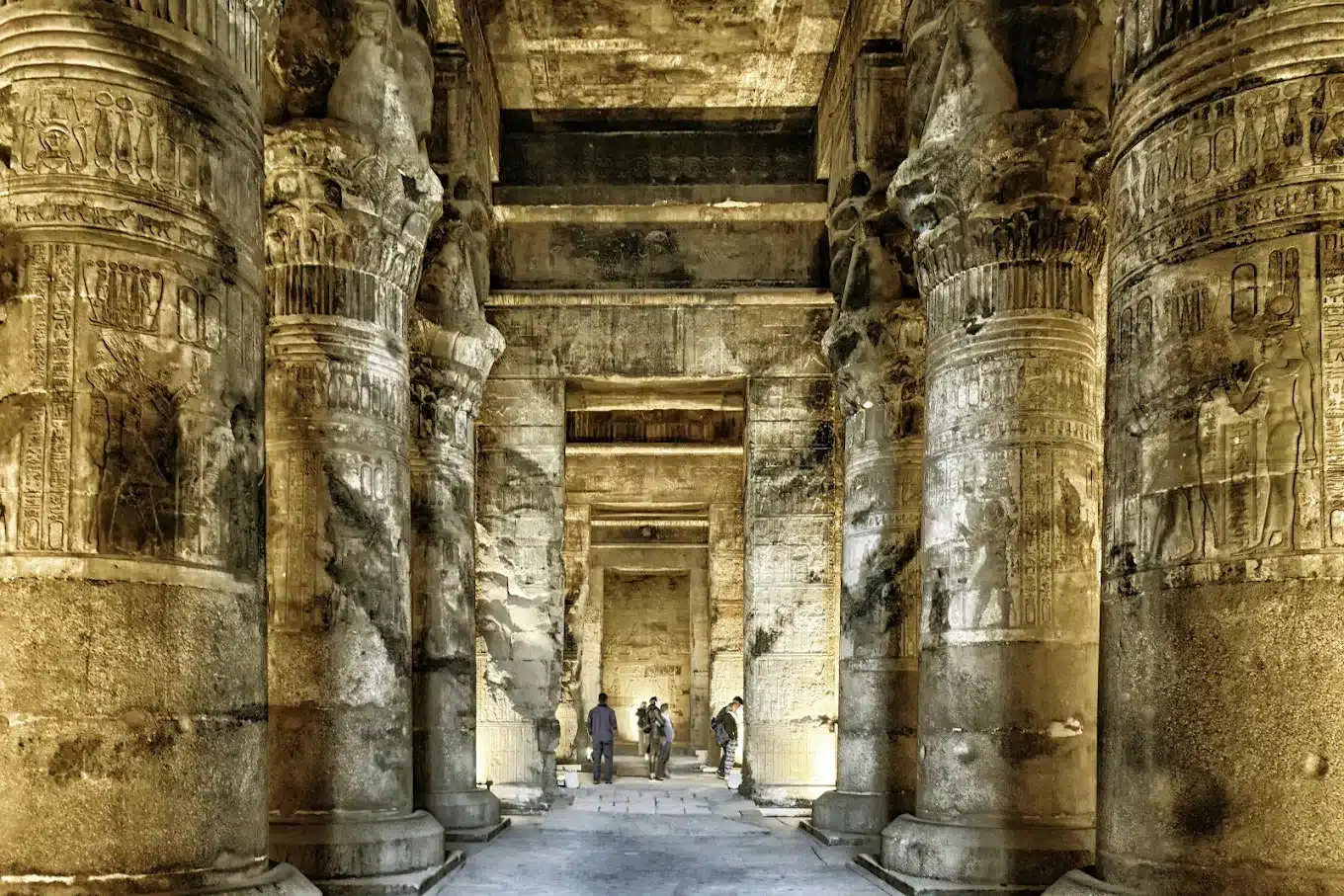
The Hypostyle Hall: Step inside, and you enter one of the most beautiful spaces in Egypt. The hall is supported by 24 massive columns, each topped with a capital carved in the shape of Hathor’s face.
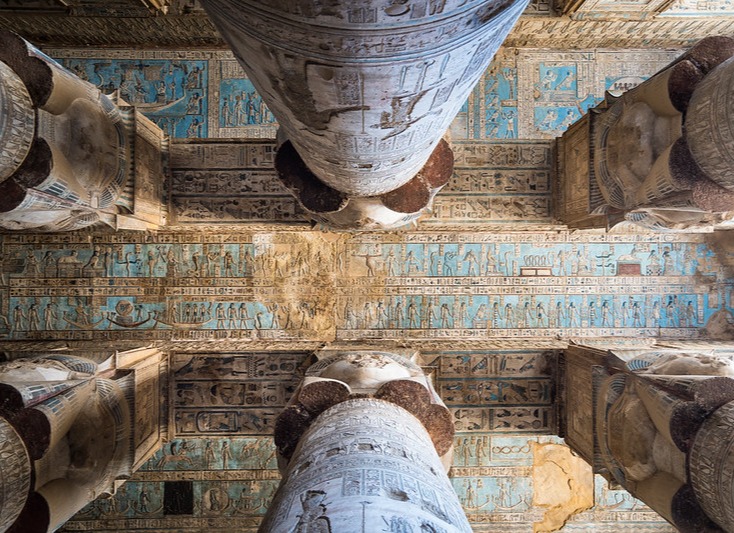
The columns are not plain. They are covered with hieroglyphs and reliefs. The ceiling is dark with soot from fires lit here over the centuries. But if you look up, you can see painted astronomical scenes—the sky goddess Nut swallowing the sun, the stars, and the constellations.
The Sanctuary: Beyond the hypostyle hall lies the sanctuary, the most sacred part of the temple. Here, the statue of Hathor would have been kept. Only the pharaoh or high priest could enter.
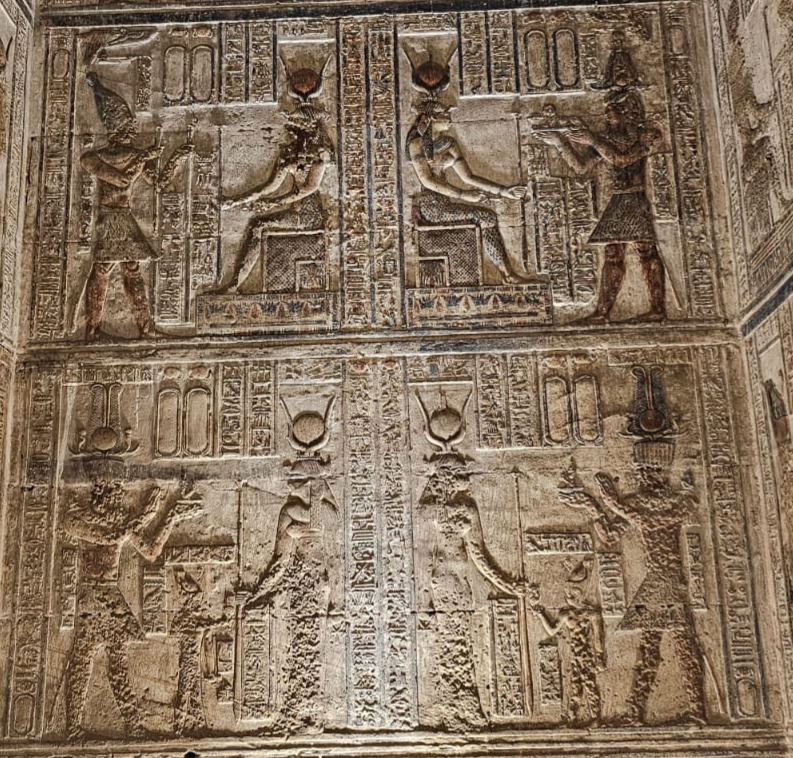
The sanctuary is small but beautifully decorated. The walls show the pharaoh making offerings to Hathor and other gods.
The Chapels: Around the sanctuary are several chapels dedicated to other gods, including Isis, Osiris, Horus, and Sokar. Each chapel has its own reliefs and symbolism.
The Crypts
Beneath the temple, there is a network of crypts—narrow, hidden chambers cut into the stone. These were used to store sacred objects, temple treasures, and cult statues.
The crypts are unique because their walls are decorated. You can see reliefs of gods, pharaohs, and ritual scenes. In one crypt, there is a famous relief of what looks like a light bulb (more on that later).
The Roof
The roof of the temple is accessible by a staircase. On the roof, you find:
- Chapels dedicated to Osiris – where mysteries of his resurrection were celebrated
- Views of the surrounding countryside – the Nile, green fields, and desert
- The famous Zodiac Ceiling (now in Paris, but a copy remains)
The Birth House (Mammisi)
Outside the main temple, there is a smaller structure called the mammisi, or “birth house.” It celebrates the divine birth of Horus, the son of Isis and Osiris, who was also linked to Hathor.
The walls show scenes of the god’s conception, birth, and childhood. These were important for royal ideology—the pharaoh was considered the living Horus.
The Sacred Lake
Every major temple had a sacred lake. At Dendera, the lake is still visible. Priests used it for purification rituals. It may also have been used for festivals, with boats carrying statues of the gods across the water.
The Mysteries of Dendera
The Dendera Light Bulb
One of the most famous—and most debated—images at Dendera is found in one of the crypts.
The relief shows a large, bulb‑shaped object with a snake inside. A cord leads from the object to a box, and a figure holds the object aloft.
Some people believe this shows that the ancient Egyptians had electricity. They call it the “Dendera light bulb.”
What scholars say: Most Egyptologists reject this theory. They interpret the scene as a religious symbol. The snake represents the god Harsomtus, who was a form of Horus. The “bulb” is actually a djed pillar (a symbol of stability) or a representation of the womb of Nut (the sky goddess) from which the sun was born.
The scene probably depicts the creation of the world or the rebirth of the sun—not a light bulb.
Still, the theory persists. It has appeared in books, documentaries, and websites. When you see it, you can decide for yourself.
The Zodiac Ceiling
The ceiling of one chapel on the roof originally contained a circular zodiac—a map of the stars and constellations as the Egyptians saw them.
The Dendera Zodiac is one of the most famous artifacts from ancient Egypt. It shows:
- The 12 signs of the zodiac (as we know them)
- The planets (as the Egyptians knew them)
- Constellations, including Orion and Sirius
- Decans – 36 star groups used to tell time at night
The original zodiac was removed in 1821 and is now in the Louvre Museum in Paris. A plaster copy sits in its place.
The zodiac is important because it shows how Greek and Egyptian astronomy merged during the Ptolemaic period.
The Cleopatra Connection
Dendera has a famous relief showing a queen making offerings to the gods. Some people believe this is Cleopatra VII—the last queen of Egypt.
The relief shows a woman with her son. She is dressed in Egyptian style and holds a sistrum (a musical instrument sacred to Hathor).
If it is Cleopatra, it is one of the few images of her in Egypt. But not all scholars agree. It could be another Ptolemaic queen.
Visiting Dendera Temple Today
How to Get There
From Luxor:
- By car: About 1.5 to 2 hours north.
- By tour: Most visitors book a private tour or join a group excursion.
- Often combined with Abydos (another 1.5 hours north).
From Qena: Dendera is just a few kilometers from the town of Qena. Taxis are available.
What to See
Plan to spend at least 2 to 3 hours at Dendera. Highlights include:
- The hypostyle hall with Hathor‑headed columns
- The crypts (if open)
- The roof and the copy of the zodiac
- The birth house
- The sacred lake
Best Time to Visit
- Morning (8:00–11:00 AM): Good light, cooler temperatures.
- Late afternoon: Beautiful light on the stone.
Dendera is less crowded than Luxor’s temples. You may have parts of it to yourself.
Tips for Your Visit
- Wear comfortable shoes. You will walk on stone floors and climb stairs.
- Bring a flashlight. The crypts are dark, and a flashlight helps you see the reliefs.
- Hire a guide. The stories behind the reliefs bring the temple to life.
- Take your time. Sit in the hypostyle hall. Look up at the ceiling. Absorb the atmosphere.
Combining Dendera with Abydos
Many visitors combine Dendera with the Temple of Abydos, another of Egypt’s most important sites.
Abydos is about 80 kilometers (50 miles) north of Dendera. It was the center of the cult of Osiris, god of the afterlife.
Why combine them:
- Both are north of Luxor, so you save time.
- Both are beautifully preserved.
- Both offer unique insights—Dendera for Hathor, Abydos for Osiris.
Typical itinerary:
- 7:00 AM – Depart Luxor
- 8:30 AM – Arrive Dendera, tour for 2 hours
- 10:30 AM – Drive to Abydos
- 12:00 PM – Arrive Abydos, tour for 2 hours
- 2:00 PM – Lunch
- 4:00 PM – Return to Luxor
It is a long day, but it is one of the best day trips you can do from Luxor.
Dendera in Popular Culture
Dendera has appeared in:
- Documentaries about ancient Egyptian religion and astronomy
- Books on the mysteries of Egypt
- Websites and videos about the “Dendera light bulb” theory
Its beauty and mysteries continue to attract visitors and researchers alike.
Preservation and the Future
Dendera is well preserved, but it faces challenges:
- Weathering from wind and occasional rain
- Tourist traffic – millions of visitors over time
- Soot and grime from centuries of use
The Egyptian government, working with international teams, continues to:
- Clean and stabilize the reliefs
- Monitor the structural integrity
- Improve the visitor experience
The temple is safe for now and will remain a treasure for future generations.
Why Dendera Matters
Dendera is not the biggest temple in Egypt. It is not the oldest. But it is one of the most beautiful and most interesting.
It shows us:
- How the Greeks and Romans honored Egyptian gods
- What the Egyptians believed about the stars and the sky
- How religion was practiced in the last centuries of ancient Egypt
- That mystery and wonder still surround these ancient stones
When you stand in the hypostyle hall, surrounded by the faces of Hathor, looking up at the soot‑darkened ceiling, you feel connected to something ancient and profound.
Explore More
- Nile Cruise Deals
- Dahabiya Nile Cruise Guide
- Planning a Trip to Egypt
- Luxor to Aswan Nile Cruise
- Valley of the Kings
- Hatshepsut Temple
- Karnak Temple
- Temple of Abydos
- Kom Ombo Temple
- Philae Temple
- Abu Simbel Temples
- Hot Air Balloon in Luxor
- Nile Cruise vs Land Tour
- Lake Nasser Cruise
Plan Your Journey
Experience the Magic of Dendera with Top Nile Cruises
Let us craft the perfect Egypt itinerary for you. From the sacred halls of Dendera to the majestic Nile, your adventure awaits.
+2 0100 868 4777 | booking@topnilecruises.com
Want to read more? Check the Wikipedia article.
Frequently Asked Questions
Where is Dendera Temple located?
Dendera Temple is located near the town of Qena, about 60 kilometers north of Luxor on the west bank of the Nile.
What is the Dendera light bulb?
A controversial relief in the crypts that some believe shows an ancient light bulb. Most scholars interpret it as a religious symbol.
Who is Hathor?
Hathor was the ancient Egyptian goddess of love, music, joy, and motherhood. Dendera was her main cult center.
Can you visit Dendera Temple?
Yes. Dendera is open to visitors year-round. It is often combined with a trip to Abydos.