
Unfinished Obelisk: Legacy of Unfinished Splendor in Aswan
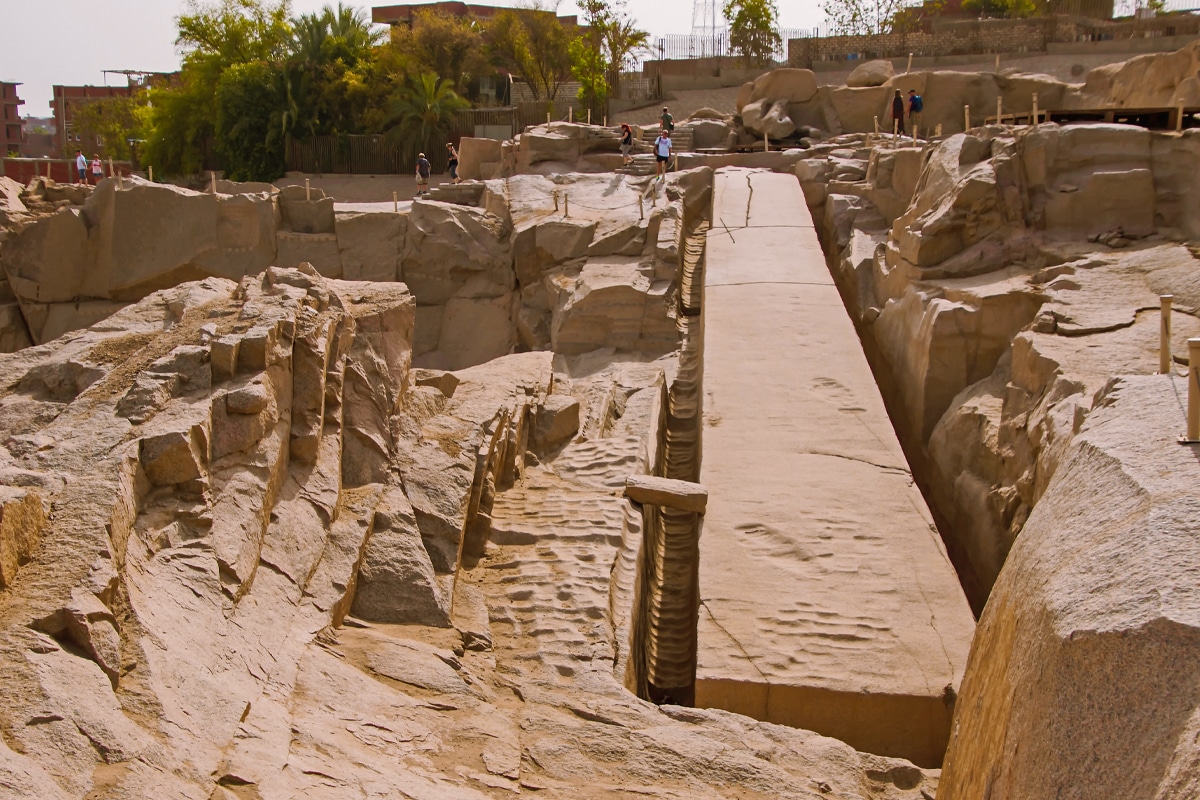
In the northern region of the Aswan quarry, lying on its side still attached to the bedrock, is one of Egypt’s most fascinating ancient monuments. It is not a temple or a tomb. It is a giant piece of stone that was never finished.
This is the Unfinished Obelisk. If it had been completed, it would have been the largest obelisk ever built by the ancient Egyptians—taller than any standing today.
But a crack appeared in the stone. The workers abandoned it. And there it has remained for over 3,400 years.
Today, the Unfinished Obelisk is one of Aswan’s top attractions. It offers a unique window into how the ancient Egyptians quarried, shaped, and transported their massive stone monuments. In this guide, we will explore its history, the mystery of its abandonment, and what it teaches us about ancient engineering.
What Is an Obelisk?
Before we dive into the Unfinished Obelisk, it helps to understand what obelisks were and why the Egyptians built them.
An obelisk is a tall, four-sided stone pillar with a pyramid-shaped top called a pyramidion. The ancient Egyptians carved them from a single block of stone, usually granite.
Symbolism of Obelisks
Obelisks were deeply symbolic. They represented:
- The sun god Ra – The pyramidion at the top was often covered in gold or electrum to catch the first rays of the morning sun.
- A ray of sunlight – The shape itself, tapering upward, mimicked a beam of light.
- Divine connection – Obelisks were believed to connect the earth to the heavens, channeling the sun god’s energy down to the pharaoh and the people.
Where Obelisks Were Placed
Obelisks were usually erected in pairs at the entrances of temples. They stood as markers of sacred space and as monuments to the pharaoh’s power and devotion to the gods.
The hieroglyphs carved on their sides recorded the king’s achievements, his relationships with the gods, and prayers for his eternal reign.
The Aswan Quarry: Egypt’s Granite Factory
Most of Egypt’s obelisks and many of its statues were carved from granite quarried near Aswan.
Why Aswan?
Aswan was the source of the highest quality granite in Egypt. This stone, called syenite, is hard, durable, and takes a fine polish. It was prized for monuments that needed to last forever.
The quarries are located on the east bank of the Nile, close enough to the river that heavy stones could be loaded onto barges and floated downstream to temples and cities throughout Egypt.
How Quarrying Worked
Ancient Egyptian quarrying was a brilliant combination of observation, skill, and patience.
Workers would:
- Select a suitable rock – The granite had to be free of cracks.
- Mark the shape – They drew the outline of the obelisk directly on the rock.
- Cut trenches – Using harder stones (dolerite) as pounding tools, they carved trenches around the obelisk.
- Under-cut – They cut underneath the obelisk, leaving it attached only at the bottom.
- Separate and move – Wooden wedges were driven into the cuts and soaked with water. The wood expanded, splitting the rock along the desired line.
It was slow, back-breaking work that could take years for a single obelisk.
The Unfinished Obelisk: A Monument That Never Was
The Unfinished Obelisk lies in the northern quarry, still attached to the bedrock. It is a massive piece of pink granite, and it would have been the largest obelisk ever attempted.
Dimensions and Scale
- Length: 42 meters (137 feet)
- Weight: Estimated at nearly 1,200 tons
- Base width: About 4.2 meters (13.8 feet)
To put that in perspective, the largest completed obelisk in Egypt, the Lateran Obelisk in Rome, weighs about 455 tons. The Unfinished Obelisk would have been almost three times heavier.
Who Ordered It?
Most scholars believe the obelisk was commissioned by Hatshepsut, one of Egypt’s most successful female pharaohs. She ruled in the 18th Dynasty (around 1473–1458 BCE) and built extensively at Karnak Temple, where she erected several obelisks.
One of her obelisks still stands at Karnak. It is 29 meters tall and weighs about 350 tons. The Unfinished Obelisk was meant to be even grander.
The Mystery of Abandonment
As the workers carved the obelisk from the bedrock, something went wrong.
The Fatal Crack
About one-third of the way into the carving, a large crack appeared in the granite. The crack runs through the heart of the stone, making it impossible to complete.
The crack may have been caused by:
- A natural flaw in the rock that only became visible as carving progressed
- Stress from the under-cutting process
- A mistake in the quarrying technique
Whatever the cause, the result was the same: the obelisk was useless. The Egyptians could not risk transporting and erecting a stone that might break apart.
Why They Left It
Rather than waste more time, the workers simply abandoned the project. They moved on to other stones. The obelisk remained where it was, partially carved, still attached to the earth.
For over 3,000 years, it lay there, slowly being covered by sand and debris.
What the Unfinished Obelisk Teaches Us
The Unfinished Obelisk is not just a curiosity. It is one of the most important archaeological sources for understanding ancient Egyptian stone-working techniques.
Tool Marks
Because the obelisk was never finished, the tool marks are still visible. You can see:
- Trenches where workers pounded with dolerite balls
- Smoother areas where they used copper chisels
- The grooves where wooden wedges were inserted
This is the only place in Egypt where you can see every stage of the quarrying process preserved in one place.
The Scale of Ambition
The obelisk shows us just how ambitious the ancient Egyptians were. Moving a 1,200-ton stone would have been an enormous challenge. Transporting it from the quarry to the river, loading it onto a barge, and then erecting it upright would have required engineering skills that still impress us today.
Human Effort
Thousands of workers would have been involved in this project. They were not slaves but skilled laborers, organized into teams. They worked for years, knowing that any mistake could ruin everything.
The crack in the stone must have been a devastating moment. All that work, all that effort—gone.
Visiting the Unfinished Obelisk Today
The Unfinished Obelisk is now part of an open-air museum in Aswan. It is easy to visit and often combined with other attractions.
How to Get There
- Location: About 2 kilometers south of the Aswan city center, on the east bank.
- By taxi: A short ride from anywhere in Aswan. Fare should be 20–30 EGP.
- On foot: If you are staying near the city center, it is a long but possible walk.
What to See
- The obelisk itself, lying at an angle in the quarry
- The trenches and tool marks around it
- Information panels explaining the quarrying process
- Other unfinished stones and debris from ancient quarrying
Best Time to Visit
- Morning (8:00–10:00 AM): Cooler and less crowded
- Late afternoon: Good light for photos
The site is open year-round. Allow about 30 to 45 minutes for your visit.
Nearby Attractions
The Unfinished Obelisk is usually visited as part of a tour that includes:
Philae Temple
The beautiful temple of Isis, relocated to Agilkia Island. Accessible by boat. A must-see.
Aswan High Dam
The modern engineering marvel that controls the Nile. Offers views of Lake Nasser.
Nubian Museum
Excellent exhibits on Nubian history, culture, and the rescue of ancient temples.
Elephantine Island
Ruins, a Nubian village, and a small museum. Reachable by public ferry.
Obelisks Around the World
Egyptian obelisks have traveled far. Many now stand in cities far from the Nile.
In Egypt
- Karnak Temple, Luxor – Several obelisks, including one of Hatshepsut’s
- Luxor Temple – One obelisk remains; its twin is in Paris
- Cairo Airport – A small obelisk greets arriving passengers
In Rome
Rome has more Egyptian obelisks than any other city. The Romans brought them as symbols of their conquest of Egypt.
- Lateran Obelisk – The largest standing ancient obelisk (32 meters)
- Vatican Obelisk – In the center of St. Peter’s Square
- Flaminio Obelisk – In Piazza del Popolo
In Other Cities
- Paris – The Luxor Obelisk in Place de la Concorde
- London – Cleopatra’s Needle on the Victoria Embankment
- New York – Cleopatra’s Needle in Central Park
- Istanbul – The Obelisk of Thutmose III in the Hippodrome
The Unfinished Obelisk in Popular Culture
The Unfinished Obelisk has appeared in:
- Documentaries about ancient Egyptian engineering
- Travel guides as a highlight of Aswan
- Books on ancient technology and construction
Its fame comes from its uniqueness. There is nothing else like it in Egypt.
Preservation and the Future
The Unfinished Obelisk is well preserved, but it faces challenges:
- Weathering from wind and occasional rain
- Tourist traffic – millions of visitors over time
- Vandalism – though rare, it happens
The Egyptian government has:
- Installed protective walkways
- Added information panels
- Limited access to some areas
Ongoing monitoring ensures the site remains safe for future generations.
Why the Unfinished Obelisk Matters
The Unfinished Obelisk is not a beautiful temple or a glittering treasure. It is a work in progress, frozen in time.
It shows us:
- The ambition of the pharaohs
- The skill of ancient workers
- The risks of monumental construction
- The humanity of the people who built Egypt
Standing beside it, you can almost hear the workers’ chisels, feel their frustration, and imagine their disappointment.
It is a reminder that even the greatest civilizations sometimes failed. And that is okay. The failure itself became a gift to us, thousands of years later.
Frequently Asked Questions
Why was the Unfinished Obelisk abandoned?
A large crack appeared in the granite during carving, making the obelisk unusable. The workers abandoned it in place.
How tall would the Unfinished Obelisk have been?
It would have been about 42 meters (137 feet) tall, weighing nearly 1,200 tons—the largest obelisk ever attempted.
Who built the Unfinished Obelisk?
It was likely commissioned by Pharaoh Hatshepsut during the 18th Dynasty (around 1473–1458 BCE).
Can you visit the Unfinished Obelisk?
Yes. It is an open-air museum in Aswan. Visitors can walk around the obelisk and see ancient tool marks.
Conclusion
The Unfinished Obelisk in Aswan is one of Egypt’s most fascinating sites. It is not as famous as the Pyramids or the Valley of the Kings, but it offers something unique: a direct connection to the ancient builders and their methods.
When you visit, take your time. Walk around the stone. Look at the tool marks. Imagine the effort it took. And think about the moment when the crack appeared and everything stopped.
It is a quiet place, but it speaks volumes.
Check Our Top Nile Cruise Trips:-
Plan your visit to the Unfinished Obelisk with Top Nile Cruises and step into the world of ancient Egyptian stone workers.