
Explore the Majesty of Hatshepsut Temple: A Glimpse into Ancient Egypt’s Grandeur
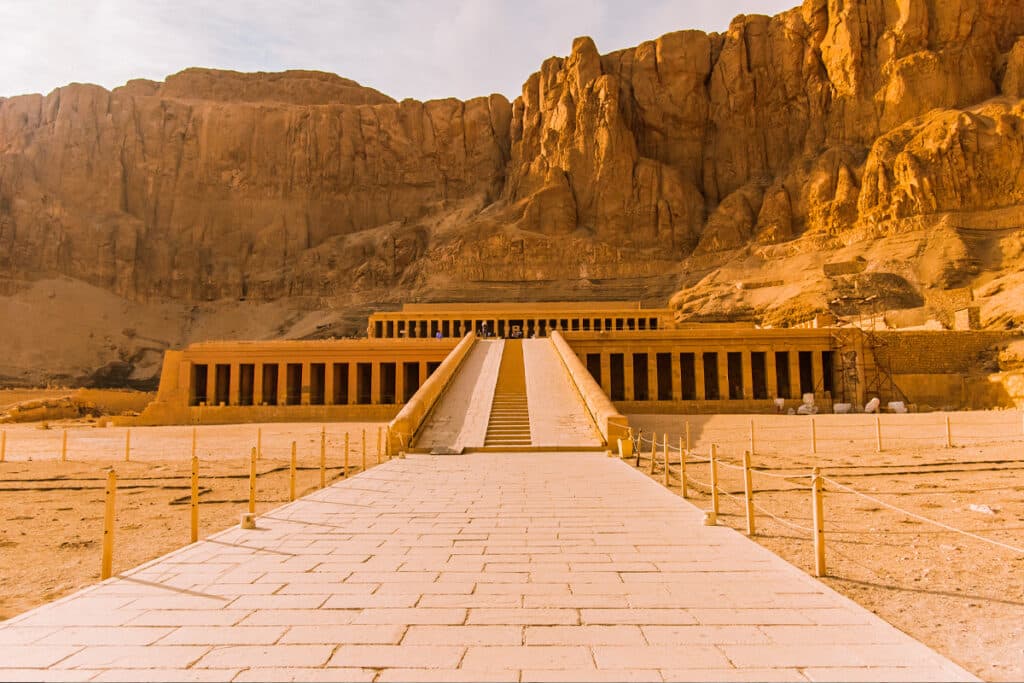
On the west bank of the Nile, across from the modern city of Luxor, a temple rises from the desert floor. It does not blend into the landscape—it emerges from it, pressed against the towering limestone cliffs of Deir el-Bahari.
This is the Temple of Hatshepsut, one of the most distinctive and beautiful monuments in all of Egypt.
Unlike the massive pylons and dark hypostyle halls of other temples, Hatshepsut’s temple is open, airy, and modern-looking. Its three terraces, connected by ramps, seem to reach for the sky. It was built not for a god alone, but for a queen who declared herself pharaoh—a woman who ruled Egypt as a king.
In this guide, we will explore the history, architecture, art, and enduring legacy of Hatshepsut Temple. We will also give you practical tips for visiting and show you why this site is an essential stop on any Egypt itinerary.
Who Was Hatshepsut?
Before we explore the temple, we must understand the woman who built it.
Hatshepsut was the fifth pharaoh of the 18th Dynasty. She ruled Egypt from around 1479 to 1458 BCE—over 20 years.
A Woman in a Man’s World
Hatshepsut was the daughter of Thutmose I and the wife of Thutmose II. When her husband died, the throne passed to Thutmose III, her stepson. But Thutmose III was too young to rule. So Hatshepsut stepped in as regent.
At first, she ruled on behalf of the boy king. But within a few years, she took the unprecedented step of declaring herself pharaoh. She adopted all the titles and symbols of kingship: the false beard, the kilt, the crown.
This was almost unheard of. There had been female rulers before, but none had taken full pharaonic power so completely.
Her Reign
Hatshepsut’s reign was a time of peace and prosperity. She:
- Encouraged trade, especially the famous expedition to the Land of Punt (probably modern-day Somalia or Eritrea)
- Built and restored monuments across Egypt
- Launched building projects, including her magnificent temple at Deir el-Bahari
After her death, Thutmose III became pharaoh. Late in his reign, he ordered Hatshepsut’s name and image erased from many monuments. Her statues were smashed, her inscriptions chiseled out. For centuries, her achievements were almost forgotten.
Today, she is recognized as one of ancient Egypt’s most successful and fascinating rulers.
Where Is Hatshepsut Temple?
The temple is located on the west bank of the Nile, directly across from the city of Luxor. It sits at the foot of the cliffs of Deir el-Bahari, a natural amphitheater of rock.
The site was already sacred. A mortuary temple of the 11th Dynasty pharaoh Mentuhotep II stands nearby. Hatshepsut chose this location to associate herself with this earlier, powerful king.
The temple is about a 30-minute drive from the Luxor city center, past the Colossi of Memnon and through green fields and desert.
The Architecture of Hatshepsut Temple
The temple was designed by Hatshepsut’s trusted steward and architect, Senenmut. His name appears in several places within the temple, which was unusual—architects rarely signed their work.
The design is completely unlike any earlier Egyptian temple.
The Three Terraces
The temple is built on three levels, or terraces, connected by long, sloping ramps. This design mirrors the cliffs behind it, creating a harmonious blend of architecture and nature.
The Lower Terrace:
- A large courtyard, originally filled with gardens and reflecting pools.
- A row of sphinxes lined the causeway leading to the temple. Fragments of these sphinxes have been found.
- The walls are decorated with reliefs.
The Middle Terrace:
- On the north side, a chapel dedicated to Anubis, the jackal-headed god of mummification.
- On the south side, a chapel dedicated to Hathor, the cow-eared goddess of love and music. Its columns are carved with Hathor’s face.
- A colonnade with reliefs showing Hatshepsut’s divine birth and her famous expedition to Punt.
The Upper Terrace:
- The heart of the temple. Here you find the sanctuary dedicated to Amun-Ra, the king of the gods.
- Chapels for Hatshepsut’s royal cult and for her father, Thutmose I.
- A courtyard open to the sky, with statues of Hatshepsut as Osiris lining the walls (mostly damaged).
The Integration with Nature
The temple does not fight the landscape. It embraces it. The cliffs rise behind it, sheltering it. The lines of the terraces echo the lines of the rock.
This is intentional. The ancient Egyptians saw their temples as microcosms of the universe. At Hatshepsut Temple, the universe includes the mountain itself.
The Reliefs: Stories in Stone
The walls of Hatshepsut Temple are covered with some of the finest reliefs in Egypt. They tell stories that were crucial to Hatshepsut’s legitimacy and her vision of her reign.
The Divine Birth
On the middle terrace, a series of reliefs shows Hatshepsut’s divine birth. According to the story, the god Amun took the form of Hatshepsut’s father and impregnated her mother. Hatshepsut was therefore not just a human queen—she was the daughter of a god.
This was a common theme in Egyptian royal ideology. Every pharaoh claimed divine parentage. But for Hatshepsut, a woman claiming male power, it was especially important.
The Expedition to Punt
Another famous series of reliefs shows Hatshepsut’s expedition to the Land of Punt.
Punt was a distant, semi-mythical land, rich in incense, myrrh, gold, and exotic animals. The reliefs show:
- Egyptian ships arriving in Punt
- The chief of Punt and his wife (shown as obese, possibly a stylistic exaggeration)
- Loads of goods being brought onto the ships: trees (for incense), monkeys, panther skins, and gold
These reliefs were propaganda. They showed that Hatshepsut was a great pharaoh who could mount ambitious expeditions and bring wealth to Egypt.
The Obelisks
Although the obelisks themselves are gone (they stood at Karnak), the temple shows scenes of their transport and erection. This was another way of showing Hatshepsut’s power—moving massive stones required immense resources and skill.
The Destruction of Hatshepsut’s Memory
Sometime after Hatshepsut’s death, her images and names were systematically attacked.
Statues were smashed. Her cartouches were chiseled out. In the temple, her figure was often replaced with that of Thutmose III or left blank.
For a long time, scholars believed this was an act of revenge by Thutmose III, who had waited decades to rule in his own right.
Recent research suggests it may have been more complicated. The destruction may have happened late in Thutmose III’s reign, possibly for dynastic reasons—to ensure that only male kings were remembered, and to cement his son’s succession.
Whatever the reason, the damage was extensive. But it was not complete. Enough survived for us to piece together Hatshepsut’s story and recognize her greatness.
The Rediscovery of Hatshepsut
For centuries, Hatshepsut was almost unknown. Her name did not appear in the king lists. Her monuments were attributed to other kings.
In the 19th century, as Egyptologists began deciphering hieroglyphs and excavating sites, they started to piece together the puzzle.
The breakthrough came when inscriptions at Deir el-Bahari were translated. They revealed a story of a powerful female pharaoh—one who had been deliberately erased.
Since then, excavations have continued. In recent decades, archaeologists have found:
- A cache of royal mummies, including one now identified as Hatshepsut herself (based on a tooth in a jar with her name)
- Fragments of statues and reliefs
- Evidence of the temple’s original decoration and colors
Today, Hatshepsut is one of the most famous pharaohs of ancient Egypt.
Visiting Hatshepsut Temple Today
How to Get There
Hatshepsut Temple is on the west bank of Luxor. Most visitors reach it by:
- Taxi: From the east bank, about 30 minutes.
- Tour bus: Part of a West Bank tour (Valley of the Kings, Hatshepsut Temple, Colossi of Memnon).
- Bicycle or motorcycle: For the adventurous.
What to See
Plan to spend at least 1.5 to 2 hours. Highlights include:
- The three terraces and the ramps connecting them
- The Anubis Chapel on the middle terrace
- The Hathor Chapel, with its Hathor-headed columns
- The Punt reliefs on the middle terrace
- The upper terrace and the sanctuaries
- The views of the Valley of the Kings and the Nile from the temple
Best Time to Visit
- Early morning (6:00–9:00 AM): Cool, good light, fewer crowds.
- Late afternoon: Beautiful light on the stone, but the temple closes at 5:00 PM.
The temple faces east, so morning light is best for photography.
Tips for Your Visit
- Wear comfortable shoes. You will walk up ramps and stairs.
- Bring water and sunscreen. There is little shade.
- Hire a guide. The stories behind the reliefs bring the temple to life.
- Take your time. Sit on a terrace and imagine the temple as it was—painted, bustling with priests and offerings.
Combining with Other West Bank Sites
Hatshepsut Temple is usually visited as part of a West Bank tour. Other sites nearby include:
Valley of the Kings
The royal tombs of the New Kingdom pharaohs, including Tutankhamun and Ramses II.
Colossi of Memnon
Two massive statues, all that remains of the mortuary temple of Amenhotep III.
Medinet Habu
The well-preserved temple of Ramses III.
Deir el-Medina
The village of the artisans who built the royal tombs, with their own beautifully decorated tombs.
Ramesseum
The mortuary temple of Ramses II.
Hatshepsut Temple in Popular Culture
Hatshepsut Temple has appeared in:
- Documentaries about ancient Egypt and female rulers
- Books on Egyptian history and archaeology
- Films set in ancient Egypt
- Video games, including Assassin’s Creed: Origins
Its striking design makes it instantly recognizable.
Preservation and the Future
The temple has suffered damage over the centuries. Earthquakes, floods, and human destruction have taken their toll.
Restoration work has been ongoing for decades. Major projects include:
- Reconstructing fallen columns and reliefs
- Stabilizing the cliffs behind the temple
- Cleaning and conserving the remaining paint
- Improving the visitor experience with paths and signage
The work continues. Each year, more of the temple’s original beauty is revealed.
Why Hatshepsut Temple Matters
Hatshepsut Temple matters for many reasons.
- It is beautiful. The design is unique and harmonious.
- It tells a story. The reliefs are not just decoration—they are political propaganda, religious texts, and historical records.
- It honors a remarkable woman. Hatshepsut defied convention and ruled as king. Her temple is a monument to her ambition and success.
- It connects us to the past. Standing there, looking at the cliffs, you feel the weight of 3,500 years.
Frequently Asked Questions
Who built Hatshepsut Temple?
The temple was built by Queen Hatshepsut, the fifth pharaoh of the 18th Dynasty. It was designed by her architect, Senenmut.
Where is Hatshepsut Temple located?
It is located on the west bank of the Nile near Luxor, at the foot of the cliffs of Deir el-Bahari.
Why is Hatshepsut Temple famous?
It is famous for its unique three-terrace design, its beautiful reliefs, and its association with one of Egypt’s few female pharaohs.
What is the best time to visit Hatshepsut Temple?
Early morning (6:00–9:00 AM) is best for cooler temperatures and good light for photography.
Conclusion
Hatshepsut Temple is not just another ancient site. It is a statement. A woman made it to declare her power, her divine right, and her place in history.
And despite the attempts to erase her, she is still here. Her temple still stands. Her name is still spoken.
When you walk up those ramps, you walk in the footsteps of a queen who refused to be forgotten.
Check Our Top Nile Cruise Trips:-
Plan your visit to Hatshepsut Temple with Top Nile Cruises and discover the legacy of Egypt’s greatest female pharaoh.