
Kom Ombo Temple: The Double Temple of Sobek and Horus
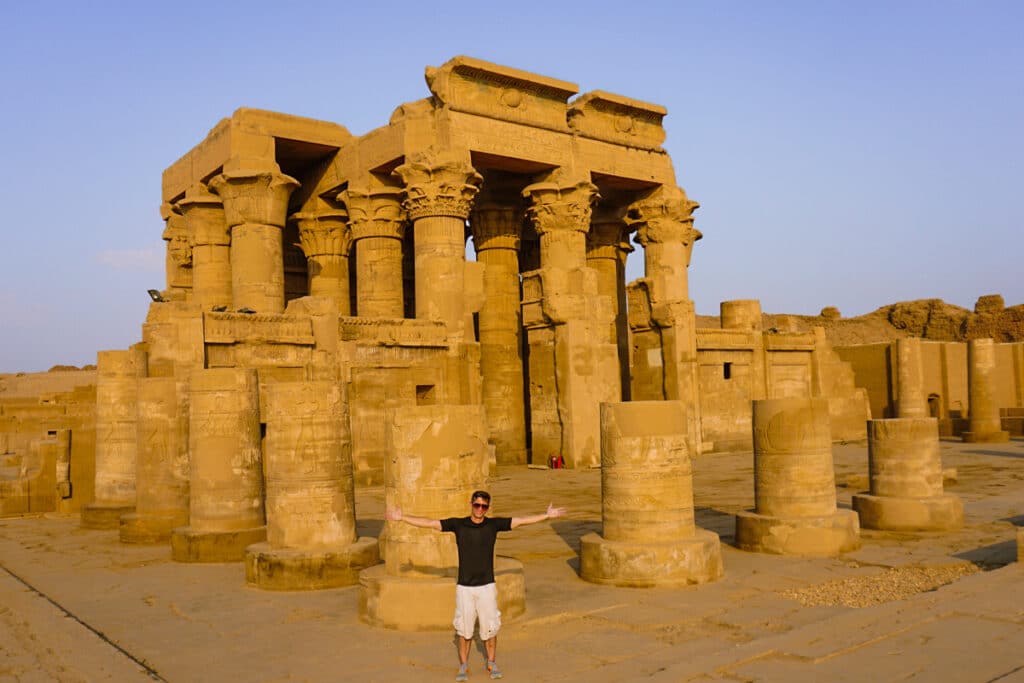
On the east bank of the Nile, about 40 kilometers north of Aswan, stands one of Egypt’s most unusual temples.
Most Egyptian temples are dedicated to a single god or pharaoh. But Kom Ombo is different. It is a double temple—two complete temples in one. The left side is dedicated to Sobek, the crocodile-headed god of fertility and protection. The right side is dedicated to Horus, the falcon-headed god of kingship and the sky. In ancient times it was called NBU which means the Gold, and in Greco Roman Era it was called OMBOS. The word Kom Ombo in Arabic means the mound, so Kom Ombo means the mound of Gold.
This duality extends throughout the temple. There are two entrances, two courts, two hypostyle halls, and two sanctuaries. Everything is perfectly symmetrical.
Kom Ombo is also famous for its reliefs of medical instruments—scalpels, forceps, and other tools that look remarkably modern. And in a small chapel nearby, you can see the mummified crocodiles that were once worshiped here.
In this guide, we will explore the history, architecture, and mysteries of Kom Ombo Temple. We will also give you practical tips for visiting and show you why this temple is a highlight of any Nile cruise.
Where Is Kom Ombo Temple?
Kom Ombo is located in the Aswan Governorate, about 40 kilometers (25 miles) north of Aswan city. It sits on a hill overlooking the Nile, with beautiful views of the river and the surrounding countryside.
The town of Kom Ombo is small, but the temple is impossible to miss. Its position on a bend in the river makes it visible from far away.
Most visitors arrive as part of a Nile cruise. Boats dock near the temple, and passengers walk up the hill to explore. If you are traveling by road, it is about a 45-minute drive from Aswan.
A Brief History of Kom Ombo
Ancient Origins
The site of Kom Ombo was sacred long before the current temple was built. Remains from the New Kingdom (around 1500 BCE) have been found here. But the temple you see today dates mainly from the Ptolemaic period (305–30 BCE) and the Roman period that followed.
Construction began under Ptolemy VI in the early 2nd century BCE. Later Ptolemies and Roman emperors added to the temple. The last additions were made under the Roman emperor Domitian (81–96 CE).
Why Two Gods?
The choice of gods reflects the local beliefs of the region.
- Sobek was associated with the Nile, with fertility, and with protection. Crocodiles were common in this part of the river, and they were seen as manifestations of the god.
- Horus was the national god of kingship, but he also had local connections. At Kom Ombo, he was worshiped as Haroeris (Horus the Elder).
The two gods were not rivals. They were complementary—representing different aspects of power and protection.
Decline and Rediscovery
After the decline of ancient Egyptian religion, the temple was abandoned. Parts of it were used as a quarry for stone. The Nile flooded the area, covering the temple in sand and silt.
In the 19th century, explorers and archaeologists began clearing the site. Excavations have continued ever since, revealing more of the temple’s secrets.
The Architecture of Kom Ombo
The temple is built of sandstone, with a design that is both traditional and unique.
The Outer Courtyard
You enter through a ruined pylon (gateway) into a large open court. This court originally had columns on three sides, but many have fallen. In the center, you can see the remains of an altar.
The Hypostyle Hall
Beyond the court is the hypostyle hall—a room with columns supporting the roof. At Kom Ombo, the hall is divided into two sections, reflecting the dual nature of the temple.
The columns are beautifully carved. Look for:
- Lotus and papyrus capitals – Symbols of Upper and Lower Egypt.
- Reliefs of the pharaoh making offerings to the gods.
- The two gods – Sobek on one side, Horus on the other.
The Inner Sanctuaries
At the back of the temple are two sanctuaries, side by side. The left sanctuary was for Sobek, the right for Horus. Each would have housed a statue of the god.
Between the sanctuaries, you can see a narrow passage used by priests for rituals.
The Outer Walls
The outer walls are covered with reliefs. Look for:
- Scenes of the pharaoh smiting enemies – a traditional image of royal power.
- Offerings to the gods – piles of food, flowers, and gifts.
- Mythological scenes – including the story of Horus and Seth.
The Medical Reliefs
One of the most famous features of Kom Ombo is a set of reliefs on the rear wall of the temple. They show a collection of medical and surgical instruments.
You can see:
- Scalpels and knives
- Forceps
- Speculums
- Dental tools
- Vessels and containers
These reliefs are unique in Egypt. They suggest that the temple was a center for healing. The priests of Kom Ombo were known for their medical knowledge, and patients may have come here seeking cures.
Some scholars believe the reliefs were a kind of “catalog” of the instruments used in the temple’s clinic. Others think they had a ritual or symbolic purpose.
The Crocodile Museum
Near the temple, a small museum houses a collection of mummified crocodiles.
In ancient times, crocodiles were sacred to Sobek. They were kept in temple pools, adorned with jewelry, and worshiped as living gods. When they died, they were mummified and buried in special cemeteries.
The museum displays:
- Mummified crocodiles of all sizes – from hatchlings to adults
- Crocodile eggs
- Crocodile statues and reliefs
It is a small museum, but it adds a fascinating dimension to your visit.
The Nilometer
Like many temples, Kom Ombo had a nilometer – a structure used to measure the height of the Nile flood.
The nilometer at Kom Ombo is a deep well, with a staircase leading down to the water. The walls are marked with measurements. By reading these, priests could predict the coming flood and advise farmers on when to plant.
You can see the top of the nilometer near the temple. It is not usually open for descent.
The Myths of Kom Ombo
The Conflict of Horus and Seth
One of the most famous Egyptian myths is the story of Horus and Seth.
Seth, the god of chaos, murdered his brother Osiris and took the throne. Osiris’s son, Horus, fought Seth for revenge and to reclaim his father’s kingdom. The battle lasted 80 years. Finally, the gods ruled in Horus’s favor, and he became king of Egypt.
This story is about the triumph of order over chaos. At Kom Ombo, Horus is shown as the victorious king.
Sobek and the Nile
Sobek was associated with the Nile’s fertility. Crocodiles were seen as protectors of the river, and they were both feared and revered.
In some myths, Sobek helps Horus in his battle against Seth. In others, he is a creator god, emerging from the primeval waters to bring order to the world.
The Sacred Pools
Kom Ombo had two sacred pools – one for each god. These were used for purification rituals and for keeping live crocodiles.
The pool of Sobek is still visible. It is rectangular, lined with stone, and would have been filled with water from the Nile.
Visiting Kom Ombo Temple
How to Get There
- By Nile cruise: Most cruises stop at Kom Ombo. The temple is a short walk from the dock.
- By road: From Aswan, about 45 minutes north. Taxis and tours are available.
- By train: Kom Ombo has a train station, but most visitors arrive by cruise or tour.
Best Time to Visit
- Morning (8:00–10:00 AM): Cooler, good light.
- Late afternoon: Beautiful light, but more crowded when cruise boats are in port.
How Long to Spend
About 1.5 to 2 hours. This allows time for the temple, the crocodile museum, and photos.
Tips for Your Visit
- Wear a hat and sunscreen. There is little shade.
- Bring water. It gets hot.
- Look for the medical reliefs on the rear wall.
- Visit the Crocodile Museum. It is included in your ticket.
- Take your time. The symmetry of the temple is worth studying.
Combining Kom Ombo with Other Sites
Kom Ombo is usually visited as part of a Nile cruise itinerary. A typical day might be:
- Morning: Sail to Kom Ombo
- Late morning: Visit the temple
- Afternoon: Sail to Edfu
If you are traveling by road, you can combine Kom Ombo with:
- Edfu Temple – 65 kilometers north
- Aswan – 40 kilometers south
Kom Ombo in Popular Culture
Kom Ombo has appeared in:
- Documentaries about ancient Egyptian medicine
- Travel guides as a highlight of Nile cruises
- Books on Egyptian mythology
Its unique dual design and medical reliefs make it a favorite among visitors.
Preservation and the Future
Kom Ombo faces challenges:
- Rising groundwater from the Nile and nearby agriculture
- Weathering from wind and occasional rain
- Tourist traffic – millions of visitors over time
The Egyptian government, working with international teams, continues to:
- Monitor and stabilize the structure
- Drain groundwater
- Clean and conserve the reliefs
The temple is in good condition and will remain a highlight of Nile cruises for generations.
Why Kom Ombo Matters
Kom Ombo is not the biggest or oldest temple in Egypt. But it is unique.
Nowhere else will you find a temple so perfectly balanced between two gods. Nowhere else will you see reliefs of surgical instruments carved in stone. Nowhere else will you find a museum of mummified crocodiles next to a working temple.
Kom Ombo reminds us that ancient Egypt was not a single, uniform culture. It was a collection of local beliefs and practices, all woven together by a shared mythology and a common devotion to the gods.
Frequently Asked Questions
Why is Kom Ombo Temple called a double temple?
It is dedicated to two gods: Sobek (the crocodile god) and Horus (the falcon god). The temple has two of everything—entrances, courts, halls, and sanctuaries.
What are the medical reliefs at Kom Ombo?
They are carvings of surgical instruments, including scalpels, forceps, and speculums. They suggest the temple was a center for healing.
Where is Kom Ombo Temple located?
It is located about 40 kilometers north of Aswan, on the east bank of the Nile.
Can you see mummified crocodiles at Kom Ombo?
Yes. The Crocodile Museum, near the temple, displays mummified crocodiles of all sizes.
Conclusion
Kom Ombo Temple is a gem. It is small enough to explore in a couple of hours, but rich enough to reward close attention.
As you walk through its symmetrical halls, look for the differences between the two sides. Notice how the reliefs honor Sobek on one side and Horus on the other. Imagine the priests moving between the sanctuaries, performing rituals for two gods at once.
And when you see the medical instruments, think about the patients who came here seeking healing, and the priests who used these tools to help them.
Kom Ombo is a place of balance—between gods, between healing and worship, between the river and the desert. It is a place you will remember.
Check Our Top Nile Cruise Trips:-
Plan your visit to Kom Ombo Temple with Top Nile Cruises and discover the mysteries of Sobek and Horus.