
Temple of Abydos: Egypt’s Sacred Site and Pilgrimage Destination
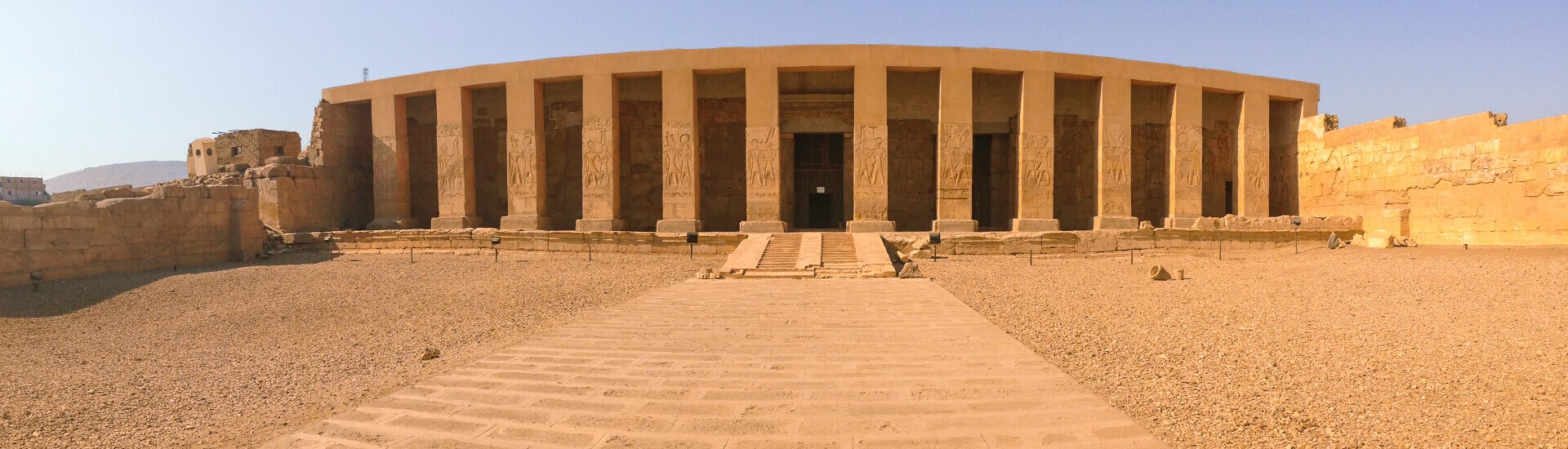
The majestic Temple of Seti I at Abydos, one of Egypt’s most sacred sites.
The Temple of Abydos is one of Egypt’s most important ancient sites. Located about 135 kilometers northwest of Luxor, this temple is dedicated to Osiris, the God of the afterlife. It attracts thousands of visitors every year who want to see its beautiful carvings, learn about Egyptian mythology, and walk through halls built over 3,000 years ago.
In this guide, we will explain the history, architecture, legends, and religious importance of the Temple of Abydos. We will also give you tips for visiting and tell you why this temple should be on your Egypt itinerary.
Where Is the Temple of Abydos?
The Temple of Abydos is located in the city of Abydos, in Upper Egypt. It lies about 135 kilometers northwest of Luxor and 400 kilometers south of Cairo.
Abydos was one of the most important religious cities in ancient Egypt. It was the center of the cult of Osiris and a major pilgrimage destination. Today, visitors can reach Abydos by car or as part of a guided tour from Luxor. Many travelers combine a visit to Abydos with a Luxor to Aswan Nile cruise for a comprehensive historical journey.
A Brief History of the Temple of Abydos
The history of Abydos goes back to the Predynastic Period, before the first pharaohs ruled Egypt. Early kings and nobles were buried here. Over time, the site became sacred to Osiris.
The Role of Pharaoh Seti I
The main temple we see today was built by Pharaoh Seti I of the 19th Dynasty, during the New Kingdom. He chose Abydos because of its deep religious roots. His son, Ramesses II, completed the temple after his father’s death.
Seti I wanted the temple to honor Osiris and other important gods. He also used it to legitimize his rule by carving the names of past pharaohs on the walls—a list now known as the Abydos King List.
Abydos as a Pilgrimage Site
For thousands of years, Egyptians traveled to Abydos to honor Osiris. They believed that participating in festivals and rituals here helped them earn a place in the afterlife. Some built small chapels or left stone inscriptions called stelae to record their visit.
The Architecture of the Temple of Abydos
The Temple of Abydos is not built in a straight line. Unlike most Egyptian temples, it has an L-shape. This unique design makes it stand out from other monuments.
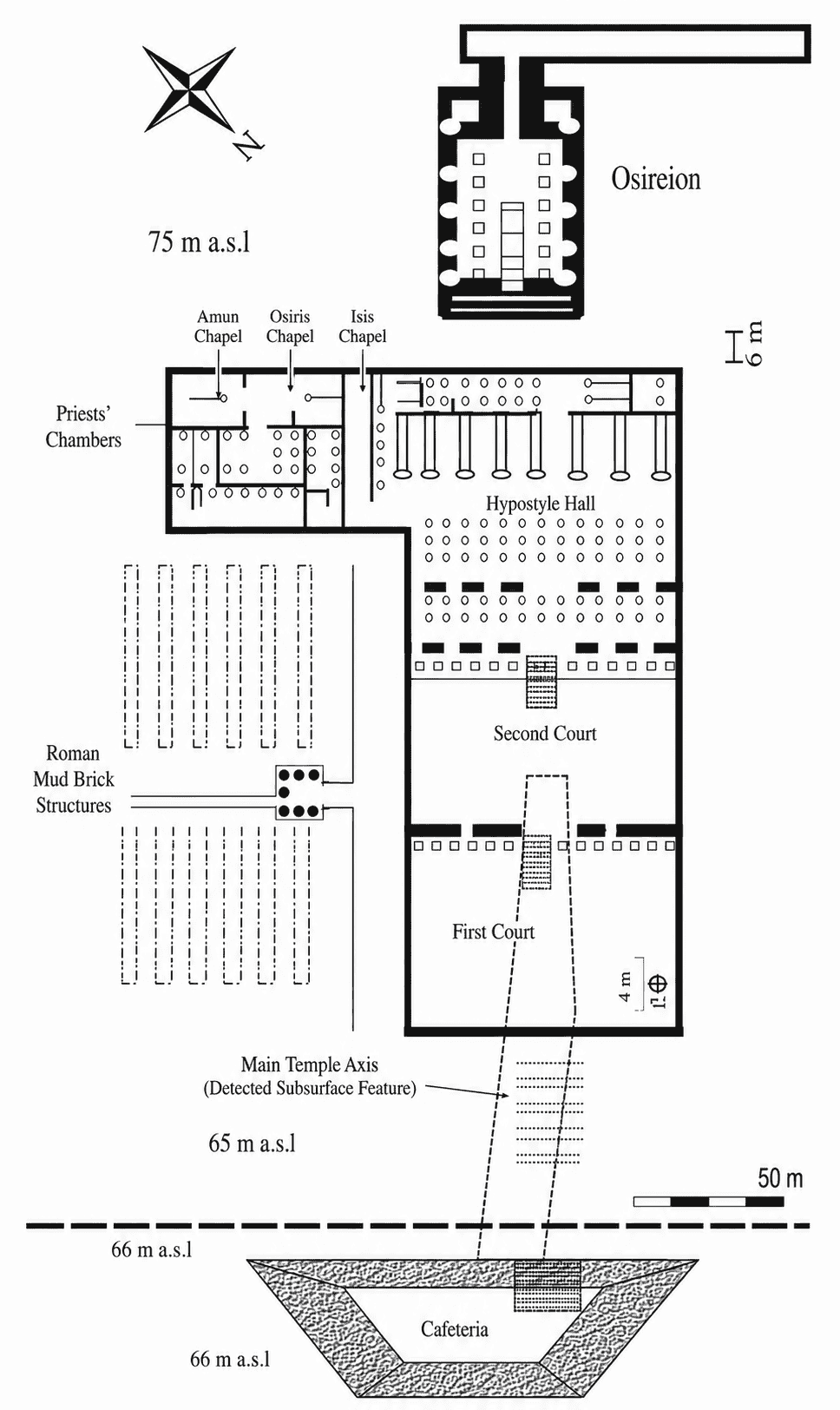
Plan of the Temple of Seti I. The layout reveals the two broad hypostyle halls leading to seven sanctuaries and the subterranean Osireion at the rear.
The Entrance and Courtyards
Visitors first enter through a large pylon gate. Beyond the gate are open courtyards where priests and pilgrims gathered for festivals. The walls are decorated with battle scenes and religious offerings.
The Hypostyle Halls
The temple has two hypostyle halls. The first hall has 24 columns made of sandstone. The carvings show Seti I standing before the gods. The second hall leads to smaller chapels dedicated to different deities.
The Chapels of the Gods
There are seven chapels inside the temple. Each one honors a different god:
- Ptah
- Re-Horakhty
- Amun-Re
- Osiris
- Isis
- Horus
- Seti I (deified)
This shows that Seti I wanted to unite the worship of many gods in one sacred space.
The Osireion: A Portal to the Underworld
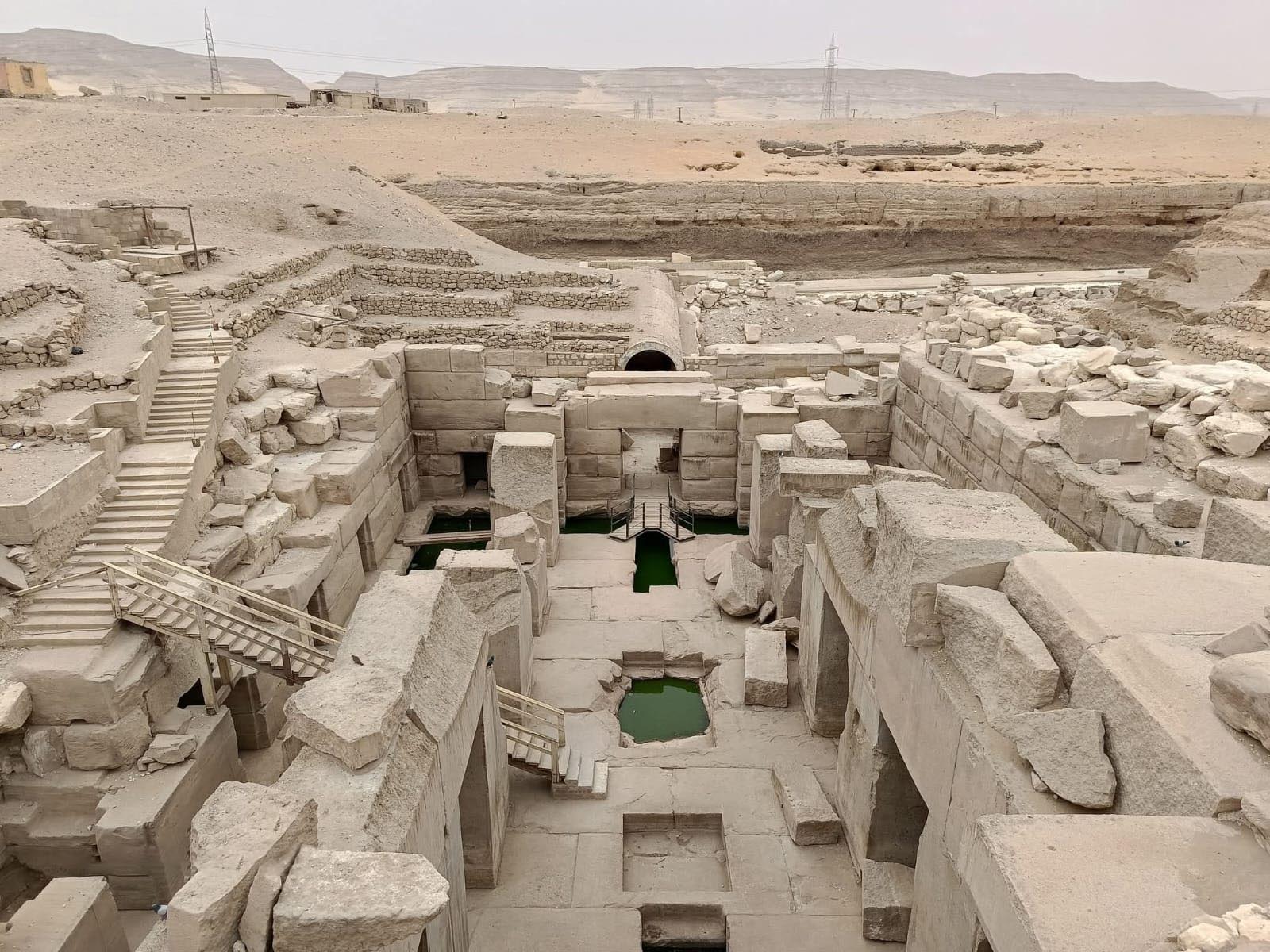
The Osireion, the enigmatic subterranean structure behind the Temple of Abydos.
Behind the main temple is one of the most mysterious structures in Egypt: the Osireion (or Osireon). This vast underground temple is built 40 feet below ground level and is constructed of massive granite blocks, some weighing as much as 60 tons.
The Spiritual Significance of the Osireion
The Osireion was designed as a cenotaph—a symbolic tomb—for Osiris. Its architecture is profoundly spiritual, evoking the primordial mound that emerged from the waters of chaos at the dawn of creation. The central chamber once contained an island surrounded by a moat, representing the moment of creation and the promise of rebirth.
For ancient Egyptians, this was not just a building but a gateway to the Duat (the underworld). Pilgrims believed that connecting with the Osireion’s energy helped them achieve a successful transition to the afterlife. The subterranean complex was decorated with scenes from the Book of Gates, a funerary text describing the soul’s journey through the underworld. This reinforces the site’s purpose as a spiritual crucible for the pharaoh’s ka (spirit).
Today, visitors often describe a profound sense of stillness and timelessness when standing near this ancient structure, feeling the weight of millennia of spiritual practice. The Osireion remains a testament to the ancient Egyptian belief that death was merely a transition to a new form of existence.
Architecture and Mystery
The style of the Osireion evokes the Valley Temple of Khafre at Giza, suggesting a deliberate attempt to connect with the antiquity of Osiris. The subterranean complex was decorated with scenes from the Book of Gates, a funerary text describing the soul’s journey through the underworld.
Visitors today cannot always enter the Osireion due to groundwater issues, but it remains one of the most fascinating and spiritually charged parts of Abydos. Its presence adds a layer of profound depth to the entire temple complex.
The Abydos King List: A Record of Pharaohs
One of the most important features of the Temple of Abydos is the Abydos King List. This is a carved relief on the wall that shows 76 cartouches, or name plaques, of pharaohs.
Seti I is shown offering incense to his royal ancestors. The list includes kings from the 1st Dynasty to the 19th Dynasty. It omits rulers like Akhenaten and Hatshepsut, likely because they were considered illegitimate or controversial.
For historians, the Abydos King List is a vital tool for understanding Egyptian chronology. It confirms the order of many dynasties and helps date other archaeological finds, often compared to the Rosetta Stone for its significance.
The Mythology of Osiris
To understand Abydos, you must understand the story of Osiris.
The Legend of Osiris and Isis
Osiris was a wise and kind king who ruled Egypt with his wife, Isis. His jealous brother, Seth, killed him and scattered his body across the land. Isis gathered the pieces and brought Osiris back to life just long enough to conceive their son, Horus.
After his death, Osiris became the ruler of the underworld. He judged the souls of the dead and offered them eternal life if they lived a pure life.
Why Abydos Became Sacred to Osiris
Ancient Egyptians believed that the head of Osiris was buried at Abydos. This made the city the holiest place in Egypt for funerary worship. Pilgrims came here to pray, leave offerings, and build memorials for their own families.
The annual Festival of Osiris reenacted his death and resurrection. It included processions, boat rituals, and dramatic performances. Thousands of people attended each year.
Religious Rituals at the Temple
The Temple of Abydos was not just a monument—it was a living religious center. Priests performed daily rituals to care for the gods.
Daily Offerings
Every morning, priests entered the chapels to wash, dress, and feed the statues of the gods. They offered food, water, incense, and ointments. These rituals were believed to maintain cosmic order, or ma’at.
Festivals and Processions
During major festivals, statues of the gods were carried out of the temple on ceremonial boats. Pilgrims sang, danced, and made offerings. The most important festival was the “Great Going Forth,” which celebrated Osiris returning to life.
Why the Temple of Abydos Was So Important
The Temple of Abydos was important for religious, political, and cultural reasons.
- Religious center: It was the main cult site of Osiris, the God of resurrection.
- Royal legitimacy: Pharaohs like Seti I used the temple to connect themselves to earlier dynasties.
- Pilgrimage destination: Egyptians from all social classes traveled here to seek blessings.
- Architectural innovation: The L-shaped design and Osireion are unique in Egyptian temple building.
Mysteries and Legends
Like many ancient sites, Abydos is surrounded by unsolved mysteries.
The Helicopter Hieroglyph
One of the most famous carvings at Abydos looks like a helicopter, submarine, and airplane. Some people believe this is evidence of advanced technology or time travel. Archaeologists explain it as palimpsest—older carvings that were reshaped by later carvings, creating overlapping images that look modern. It is a fascinating example of how erosion and re-carving can create optical illusions.
Hidden Chambers
Some researchers believe there are undiscovered tunnels or rooms beneath the temple. Ground scans have shown anomalies, but no major excavation has confirmed them yet.
These mysteries make Abydos even more intriguing to visitors and scholars alike.
Preservation and Restoration
The Temple of Abydos has survived for over 3,000 years, but it faces threats from weather, groundwater, and tourism.
Egyptian authorities, working with international teams, have:
- Cleaned and stabilized the wall carvings
- Repaired damaged stonework
- Installed drainage systems to protect the foundation
Ongoing work ensures that future generations can continue to visit and study this important site.
Visiting the Temple of Abydos Today
The Temple of Abydos is open to visitors year-round. It is less crowded than Karnak or the Valley of the Kings, making it a peaceful place to explore.
How to Get There
- From Luxor: Abydos is about a 2.5-hour drive north. Many visitors book a private tour or join a group excursion. It is also a key stop on longer Dahabiya Nile cruises or itineraries that go beyond the standard Luxor to Aswan route.
- From Cairo: You can fly to Luxor and drive, or take a longer road trip through the Nile Valley. Check our travel tips for Egypt before you go.
What to See
- The Seti I Temple with its seven chapels
- The Abydos King List
- The Osireion (viewing may be restricted)
- Carvings of Seti I and Ramesses II
Best Time to Visit
The best months are October to April, when temperatures are cool. Summer visits are possible but can be very hot. Go early in the morning to avoid heat and crowds. For more tips, read our guide on how to spend summer in Egypt.
Other Sites to Visit Near Abydos
Abydos is not the only ancient site in this region. You can also explore:
Dendera Temple Complex
Located about 80 kilometers north of Luxor, the Temple of Hathor at Dendera is one of the best-preserved temples in Egypt. It features a famous zodiac ceiling and dark, mysterious crypts.
Luxor and Karnak
Most visitors combine Abydos with a trip to Luxor. Here you can see:
- Karnak Temple
- Luxor Temple
- Valley of the Kings
- Hatshepsut’s Temple
- Colossi of Memnon
- Tomb of Tutankhamun
- Hot Air Balloon in Luxor
Adding Abydos to your Luxor itinerary gives you a deeper understanding of ancient Egyptian religion and kingship. For a truly immersive experience, consider a Nile cruise that covers these sites in style.
Frequently Asked Questions
Where is the Temple of Abydos located?
The Temple of Abydos is located about 135 kilometers northwest of Luxor, near the city of Abydos in Upper Egypt.
Who built the Temple of Abydos?
Pharaoh Seti I built the main temple. His son, Ramesses II, completed it.
What is the Abydos King List?
The Abydos King List is a carved relief showing the names of 76 pharaohs. It is an important record of Egyptian dynasties.
Can visitors go inside the Osireion?
Access is sometimes restricted due to groundwater, but visitors can often view it from above. Check local conditions before visiting.
What is the spiritual significance of the Osireion?
The Osireion is a symbolic tomb for Osiris, representing the primordial mound of creation and acting as a gateway to the underworld. It was a focal point for rituals concerning rebirth and the afterlife.
Can I visit Abydos on a Nile cruise?
Yes! Many Nile cruises include a stop at Abydos, especially longer itineraries or Dahabiya cruises that explore beyond the standard route.
Conclusion
The Temple of Abydos is more than just a collection of old stones. It is a place of faith, memory, and art. It tells the story of how ancient Egyptians understood life, death, and rebirth.
For anyone interested in history, mythology, or architecture, Abydos is a must-see destination. Its quiet setting, detailed carvings, and connection to the legend of Osiris make it one of the most rewarding sites in Egypt.
Check Our Top Nile Cruise Trips
- Standard Nile Cruises
- Deluxe Cruises
- Luxury Cruises
- Lake Nasser Cruises
- Dahabiya Boats
- Nile Cruises for Couples
- Nile Cruises with Kids
- Solo Nile Cruise Adventure
Plan Your Journey
Experience the Magic of Abydos with Top Nile Cruises
Let us craft the perfect Egypt itinerary for you. From the sacred halls of Abydos to the majestic Nile, your adventure awaits.
+2 0100 868 4777 | info@topnilecruises.com
Want to read more. Check Wikipedia article
Plan your visit to Abydos with Top Nile Cruises and step into the world of the pharaohs.