
Discover the Enigmatic Philae Temple: History, Architecture, and Egyptian Mythology
On a small island in the Nile, near the city of Aswan, stands one of the most beautiful and romantic temples in all of Egypt: the Temple of Philae.
Unlike the massive temples of Karnak or the remote majesty of Abu Simbel, Philae feels intimate. It is surrounded by water. You reach it by boat. As you approach, the temple rises from the island like a dream—carved stone, towering pylons, and the desert mountains in the distance.
Philae is dedicated to Isis, the most beloved goddess of ancient Egypt. For thousands of years, pilgrims came here to honor her. They left offerings, prayed for healing, and sought her protection.
Today, the temple is one of Egypt’s most popular attractions. But it almost disappeared forever. In the 1960s, Philae was moved—stone by stone—to save it from the rising waters of Lake Nasser.
In this guide, we will explore the history, mythology, architecture, and modern story of the Philae Temple. We will also give you practical tips for visiting and show you why this site should be on every Egypt itinerary.
Where Is the Philae Temple?
The Philae Temple is located on Agilkia Island, just south of the city of Aswan in Upper Egypt.
It originally stood on Philae Island, about 500 meters away. But after the construction of the Aswan High Dam, Philae Island was partially flooded. The temple was dismantled and rebuilt on higher ground.
Today, you reach the temple by motorboat from Aswan’s east bank. The short boat ride is part of the magic—the temple seems to float on the water as you approach.
Who Was Isis?
To understand Philae, you must first understand the goddess Isis.
In ancient Egyptian religion, Isis was the most important and enduring goddess. She was:
- The wife of Osiris, god of the afterlife
- The mother of Horus, the sky god and protector of pharaohs
- The goddess of magic, healing, motherhood, and protection
The Myth of Isis and Osiris
The story of Isis is one of the most powerful myths from the ancient world.
Osiris was a wise and good king. His jealous brother, Seth, killed him and scattered his body across Egypt. Isis, devastated, searched for every piece of her husband’s body. With her magic, she reassembled him and brought him back to life just long enough to conceive their son, Horus.
After his death, Osiris became ruler of the underworld. Horus grew up to avenge his father and become king of the living. Isis was revered as the ideal mother and wife, a protector of the vulnerable, and a source of magical power.
Her cult spread far beyond Egypt. The Greeks and Romans identified her with their own goddesses. Temples to Isis were built across the Roman Empire, as far away as London.
The History of Philae Temple
The Ptolemaic and Roman Periods
The temples at Philae were built over a long period, from about 380 BCE to 300 CE.
Most of the main temple was built by the Ptolemies, the Greek dynasty that ruled Egypt after Alexander the Great. Later rulers, including the Roman emperors, added to the complex.
Philae was one of the last places where the ancient Egyptian religion was practiced. While Egypt became Christian and later Muslim, the priests of Isis continued their rituals here for centuries.
The Last Hieroglyphs
The latest hieroglyphic inscription found anywhere in Egypt is at Philae. It dates to 394 CE, long after the pharaohs were gone. The last demotic (a simpler Egyptian script) inscription dates to 452 CE.
By then, the temple was being used as a Christian church. You can still see carved crosses and Christian symbols on some walls, added by monks who lived on the island.
The Architecture of Philae Temple
Philae is a complex of temples and shrines, not a single building. The architecture blends Egyptian and Greco-Roman styles in a way that is both unique and beautiful.
The First Pylon
The entrance to the main temple is through a massive pylon (gateway). It is about 18 meters high and covered with reliefs.
On the pylon, you can see:
- Ptolemy XII (father of Cleopatra) grabbing enemies by the hair and smiting them before the gods
- Isis, Horus, and other gods receiving offerings
- Hathor heads with cow ears, symbols of fertility and joy
The pylon would once have been topped by wooden flagpoles, with colorful flags flying in the wind.
The Forecourt
Beyond the pylon is an open courtyard, with columns on three sides. The columns have beautiful floral capitals, each one slightly different.
On the walls, you can see scenes of the pharaoh making offerings to Isis and other gods. Look for the birth house (mammisi) on one side. This small chapel celebrates the birth of Horus, the son of Isis and Osiris.
The Hypostyle Hall
A hypostyle hall is a room with columns supporting the roof. At Philae, the hall is relatively small but beautifully decorated.
The columns are covered with reliefs of Isis, Osiris, Horus, and the pharaoh. The ceiling was once painted blue with gold stars, representing the night sky.
The Sanctuary
At the heart of the temple is the sanctuary, where the statue of Isis would have been kept. Only the pharaoh or high priest could enter this holy space.
Today, the sanctuary is empty. The original statue is long gone. But you can still feel the reverence of the space. On the walls, you see Isis nursing the infant Horus—one of the most famous images in Egyptian art.
The Gate of Hadrian
Outside the main temple, near the edge of the island, stands a small but beautiful gateway built by the Roman emperor Hadrian.
It is covered with some of the finest reliefs at Philae. Look for:
- Isis and Osiris
- The god Bes, a dwarf deity who protected women and children
- The goddess Hathor, shown as a cow emerging from the mountains
The Mythology Depicted at Philae
The walls of Philae tell stories. If you know what to look for, you can read them like a book.
The Resurrection of Osiris
In several places, you see scenes of Isis using her magic to bring Osiris back to life. She is shown as a bird—a kite—hovering over his body. This image became a symbol of resurrection and eternal love.
The Birth of Horus
In the mammisi (birth house), you see scenes of Isis giving birth to Horus in the marshes of the Nile. The baby Horus is shown as a falcon or as a child with a falcon’s head.
The Protection of Isis
Isis is often shown with her wings outstretched, protecting the pharaoh. This image is one of the most beautiful in Egyptian art. It symbolizes her role as the mother and protector of Egypt.
The Judgment of the Dead
Some scenes show the weighing of the heart ceremony, where the deceased’s heart is weighed against the feather of truth. If the heart is light, the person enters the afterlife. If it is heavy, a monster eats it.
The Relocation of Philae Temple
The Threat of the High Dam
When Egypt decided to build the Aswan High Dam in the 1950s and 60s, many ancient sites were at risk. The dam would create Lake Nasser, flooding a huge area of Nubia.
Philae was directly in the path of the rising water. For part of the year, the temple was already partially submerged before the dam was built. After the dam, it would be completely under water.
An International Effort
UNESCO launched an international campaign to save the temples of Nubia. Philae was one of the most complex sites to move.
The original island of Philae was surrounded by water. Engineers first built a cofferdam—a temporary dam—around the island to pump out the water. Then, they cleaned, documented, and dismantled every stone.
The Reconstruction
The stones were transported to the nearby island of Agilkia, which was higher and would remain above the water. Agilkia was reshaped to look as much like Philae as possible.
The reconstruction took nearly 10 years. Workers had to match thousands of stones, using old photographs and drawings as guides.
In 1980, the temple reopened to the public. It looks almost exactly as it did on its original island. The rescue of Philae is considered one of the greatest achievements of modern archaeology.
Visiting Philae Temple Today
How to Get There
From Aswan, you take a motorboat from the marina near the Old Cataract Hotel. The boat ride takes about 10–15 minutes.
- Boat fare: Around 150–250 EGP per boat (negotiate before boarding)
- Time: Boats run from early morning until sunset
What to See
Plan to spend at least 1.5 to 2 hours on the island. Highlights include:
- The Great Temple of Isis
- The birth house (mammisi)
- The Gate of Hadrian
- The Kiosk of Trajan – A beautiful unfinished structure, sometimes called “Pharaoh’s Bed”
- Views of the Nile and surrounding islands
Best Time to Visit
- Morning (8:00–10:00 AM): Cooler, good light for photos, fewer crowds
- Late afternoon (3:00–5:00 PM): Beautiful golden light, still pleasant
- Evening: The temple is sometimes open for sound and light shows. Check schedules locally.
Tips for Your Visit
- Wear comfortable shoes. The island has paved paths, but you will walk.
- Bring water and sunscreen. There is little shade outside the temple.
- Hire a guide or read about the myths before you go. The stories bring the stones to life.
- Take your time. Sit by the water. Watch the boats. Let the atmosphere soak in.
- Be respectful. This is an ancient sacred site.
Exploring the Area Around Philae
A visit to Philae can easily be combined with other attractions in Aswan.
The Unfinished Obelisk
In the northern part of Aswan, you can see a massive obelisk still attached to the bedrock. If it had been finished, it would have been the largest obelisk in ancient Egypt. It broke while being carved, so it was left behind.
The Aswan High Dam
Just south of Aswan, the High Dam is a modern engineering marvel. You can drive across it and see Lake Nasser stretching south toward Sudan.
The Nubian Museum
This excellent museum tells the story of Nubia and the campaign to save its temples. Exhibits include artifacts from the flooded lands, traditional Nubian crafts, and information about the relocation of Philae and Abu Simbel.
Elephantine Island
The largest island near Aswan, Elephantine has ancient ruins, a Nubian village, and a small museum. You can reach it by public ferry.
The Nubian Villages
On the west bank of the Nile, you can visit colorful Nubian villages. Meet local families, see traditional houses, and learn about Nubian culture.
Aswan Souk
Back on the east bank, the Aswan market is perfect for shopping. Buy spices, textiles, jewelry, and souvenirs.
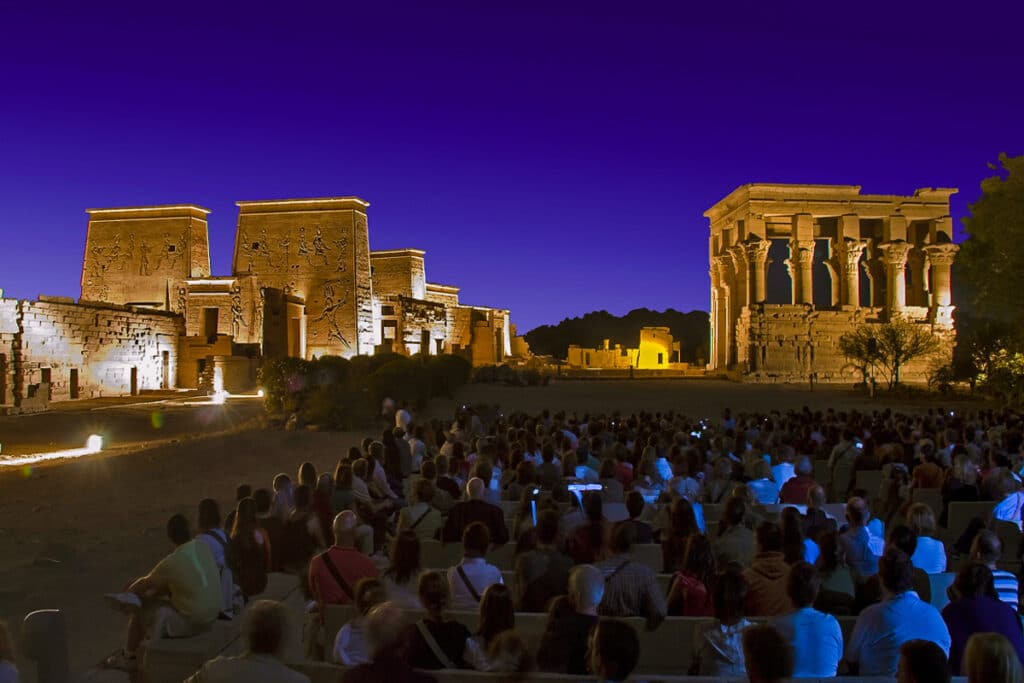
Philae Temple at Night
The Sound and Light Show at Philae is one of the best in Egypt.
As darkness falls, the temple is illuminated with colored lights. The story of Isis and Osiris is told through narration, music, and dramatic lighting.
The show lasts about an hour. You sit in an open-air theater facing the temple. It is magical—especially when the temple is reflected in the water.
Tips for the show:
- Bring a jacket—evenings can be cool.
- Arrive early for good seats.
- The show is available in multiple languages. Check schedules at your hotel.
Philae in Popular Culture
Philae has inspired artists, writers, and travelers for centuries.
- Ancient pilgrims left graffiti on the walls, recording their visits.
- 19th-century travelers wrote about the temple in their journals. Amelia Edwards, a famous travel writer, described Philae as “a dream in stone.”
- Filmmakers have used Philae as a location for movies set in ancient Egypt.
- The name “Philae” was given to a comet lander by the European Space Agency. The lander, part of the Rosetta mission, touched down on a comet in 2014.
Why Philae Matters
Philae is more than a beautiful temple. It is a symbol of continuity and survival.
- It was one of the last places where the ancient Egyptian religion was practiced.
- It became a church, adapting to a new faith.
- It was moved to save it from the waters of progress.
Standing on Agilkia Island, looking at the temple reflected in the Nile, you feel connected to all those layers of history. The pilgrims who came here 2,000 years ago. The monks who carved crosses on the walls. The engineers who moved every stone.
Philae endures. And you can be part of its story.
Frequently Asked Questions
Where is the Philae Temple located?
The Philae Temple is located on Agilkia Island near Aswan, Egypt. Visitors reach it by motorboat from the east bank.
Why was the Philae Temple moved?
The temple was moved in the 1960s and 1970s to save it from flooding caused by the construction of the Aswan High Dam.
What goddess is Philae Temple dedicated to?
The temple is dedicated to Isis, the goddess of magic, motherhood, and healing, one of the most important deities in ancient Egypt.
Can you visit Philae Temple at night?
Yes. There is a Sound and Light Show held in the evenings. The illuminated temple is spectacular against the night sky.
Conclusion
The Philae Temple is a jewel of the Nile. It is beautiful, mysterious, and deeply moving.
Whether you come for the history, the mythology, or simply the beauty of the place, you will leave with memories that last a lifetime.
As your boat pulls away from the island, turn back for one last look. The temple will be there, glowing in the sunlight, waiting for the next visitor to discover its secrets.
Check Our Top Nile Cruise Trips:-
Plan your visit to Philae Temple with Top Nile Cruises and step into the world of Isis, the goddess of magic and love.