
Abu Simbel Temples: A Glimpse into Ancient Egyptian Marvels
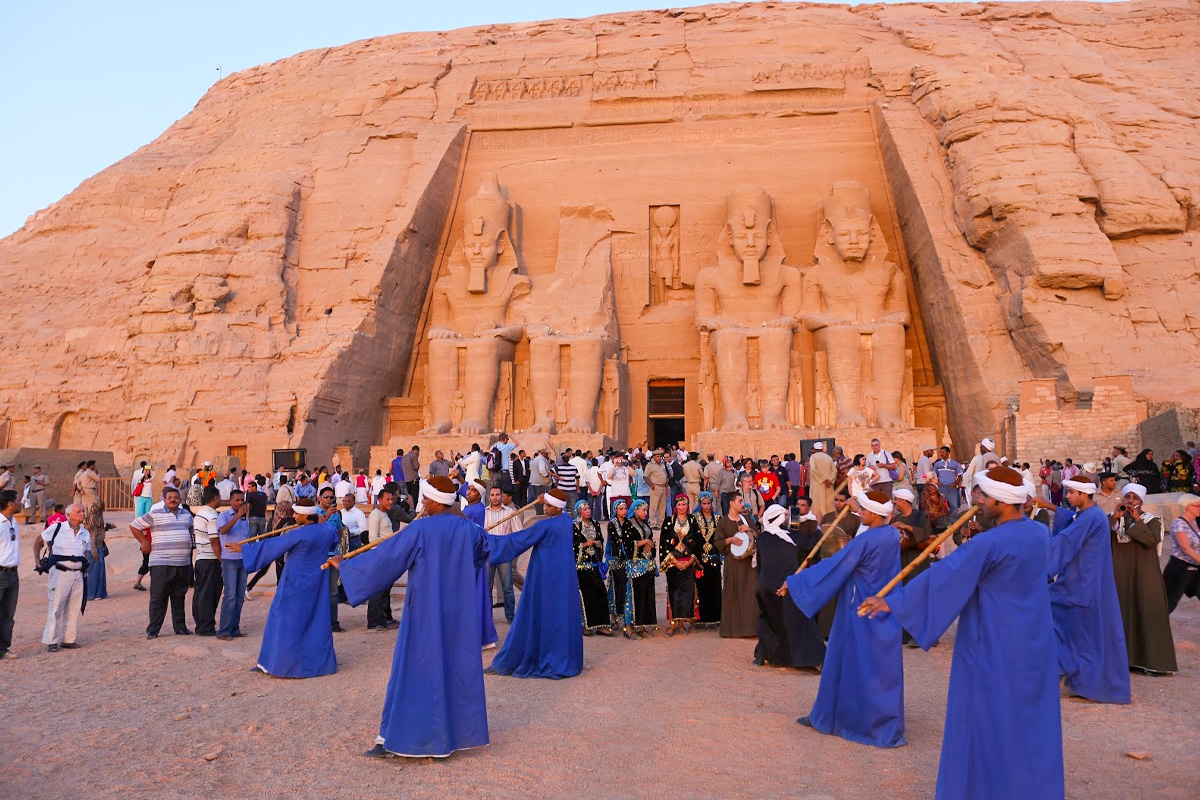
Deep in southern Egypt, near the border with Sudan, two massive temples rise from the desert. They are not built on the ground—they are carved into it. These are the Abu Simbel Temples, and they are among the most spectacular monuments ever created.
Commissioned by Pharaoh Ramesses II in the 13th century BCE, Abu Simbel was meant to impress. It was a statement of power, a religious shrine, and a lasting tribute to the king’s favorite wife, Nefertari. Today, it is a UNESCO World Heritage Site and one of Egypt’s most visited attractions.
In this complete guide, we will explore the history, architecture, relocation, and cultural significance of Abu Simbel. We will also give you practical tips for visiting and explain why these temples should be at the top of your Egypt itinerary.
Where Are the Abu Simbel Temples?
The Abu Simbel Temples are located in Nubia, southern Egypt, about 280 kilometers south of Aswan. They sit on the western bank of Lake Nasser, the massive reservoir created by the Aswan High Dam.
The site is remote. There is no town nearby—only the temples, a visitor center, and a small airport. This isolation adds to the magic. Approaching Abu Simbel feels like discovering a lost world.
Who Built Abu Simbel and Why?
Pharaoh Ramesses II
Ramesses II, also known as Ramesses the Great, ruled Egypt for 66 years (1279–1213 BCE). He was a warrior, a builder, and a master of propaganda. No pharaoh built more monuments or left more statues of himself.
Ramesses built Abu Simbel for two reasons:
- To impress Egypt’s southern neighbors. The temples stand near the border with Nubia (modern Sudan). Their colossal size was meant to show anyone entering Egypt that they were entering the land of a god-king.
- To honor the gods and his queen. The Great Temple is dedicated to Ra-Horakhty, Ptah, and Amun—but also to Ramesses himself. The Small Temple honors Queen Nefertari and the goddess Hathor.
The Date of Construction
Work began around 1264 BCE and took about 20 years to complete. The temples were carved directly into the sandstone cliff, a technique that required immense skill and planning.
The Great Temple of Ramesses II
The Great Temple is the larger of the two structures. It is famous for its four colossal statues of Ramesses II seated on thrones.
The Facade
The facade is 33 meters wide and 30 meters high—about the height of a 10-story building.
- Four statues of Ramesses II, each 20 meters tall
- Above the entrance, a niche holds a statue of Ra-Horakhty, the sun god
- Smaller statues at the feet of Ramesses represent his children, wives, and mother
The statues are not identical. Their faces show Ramesses at different ages. The second statue from the left was damaged in an ancient earthquake. Its upper body lies on the ground in front of the temple.
The Interior
Inside, the temple is laid out like a typical Egyptian temple but carved into rock.
First Hall (The Hypostyle Hall):
- Eight pillars show Ramesses as the god Osiris
- Walls are covered with reliefs showing Ramesses’ military victories, including the Battle of Kadesh
- Prisoners of war are shown bound and defeated
Second Hall:
- Leads to the sanctuary
- Decorated with scenes of Ramesses and the gods
The Sanctuary:
- The innermost room
- Contains four seated figures: Ptah, Amun, Ramesses II, and Ra-Horakhty
The Solar Alignment
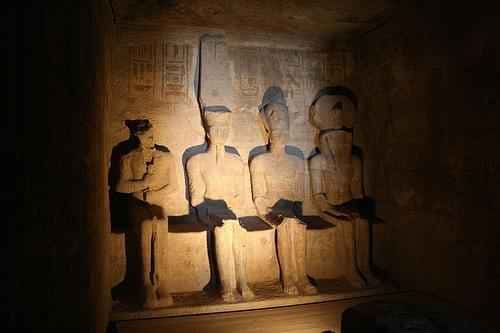
Twice a year, sunlight reaches the sanctuary and illuminates three of the four statues. The only statue left in shadow is Ptah, who was associated with the underworld and darkness.
These dates are:
- February 22 – Ramesses’ coronation date
- October 22 – Ramesses’ birthday
Today, thousands of visitors gather at Abu Simbel on these mornings to watch the phenomenon. It is known as the Sun Festival.
The Small Temple of Hathor and Nefertari
About 100 meters from the Great Temple stands a smaller temple. It is dedicated to Hathor, the goddess of love and music, and to Queen Nefertari, Ramesses’ favorite wife.
The Facade
The facade features six standing statues, each about 10 meters tall:
- Four statues of Ramesses II
- Two statues of Queen Nefertari
This is extremely unusual. In Egyptian art, queens were normally shown much smaller than their husbands. At Abu Simbel, Nefertari appears the same size as the king—a sign of her importance.
The Interior
Inside, the temple is decorated with scenes showing:
- Ramesses making offerings to the gods
- Nefertari playing the sistrum (a musical instrument) before Hathor
- The goddess Hathor as a cow emerging from the mountain
The sanctuary contains a statue of Hathor as a divine cow, protecting Ramesses.
The History of Abu Simbel After Ramesses
After the New Kingdom ended, Abu Simbel was gradually abandoned. Wind and sand buried the temples. By the 6th century BCE, they were completely covered.
For over 2,000 years, no one knew the temples existed.
Rediscovery
In 1813, a Swiss explorer named Johann Ludwig Burckhardt found the top of one of the colossal statues sticking out of the sand. He told another explorer, Giovanni Belzoni, about his find.
In 1817, Belzoni dug his way into the temple. He found the interior full of sand, but the reliefs were perfectly preserved. News of the discovery spread across Europe.
The Relocation: Saving Abu Simbel
In the 1950s, Egypt decided to build the Aswan High Dam. The dam would create Lake Nasser, flooding a huge area of Nubia—including Abu Simbel.
An International Effort
The Egyptian government and UNESCO launched a campaign to save the temples. It was one of the largest engineering challenges ever attempted.
Between 1964 and 1968, an international team:
- Cut the temples into blocks – Over 1,000 blocks, each weighing up to 30 tons
- Lifted them to higher ground – 65 meters above their original location
- Reassembled them exactly – Like a giant 3D puzzle
- Built artificial hills – To recreate the original setting
The cost was about $40 million (equivalent to over $300 million today). Countries around the world donated money and expertise.
The temples now stand on a man-made cliff overlooking Lake Nasser. The relocation is considered one of the greatest achievements of modern engineering.
Why Abu Simbel Is So Important
Political Significance
Abu Simbel was a warning. Nubia was rich in gold and other resources. By building this temple at Egypt’s southern border, Ramesses was telling the Nubians: You are entering the land of a god. Behave accordingly.
Religious Significance
The temples show how Egyptian religion blended with royal power. Ramesses is shown making offerings to the gods—but he is also shown as a god. The sanctuary scene, where his statue sits with the great gods, makes him part of the divine family.
Artistic Significance
The reliefs at Abu Simbel are masterpieces. The Battle of Kadesh scenes are some of the most detailed military images from ancient Egypt. The statues of Ramesses and Nefertari are among the finest examples of royal portraiture.
Modern Significance
The relocation of Abu Simbel showed the world that heritage matters. It was the first time countries came together to save a monument not because it was in their own country, but because it belonged to all humanity. This spirit led to UNESCO’s World Heritage Convention.
Visiting Abu Simbel Today
How to Get There
By air:
- Daily flights from Cairo and Aswan to Abu Simbel Airport
- Flight time from Aswan: about 45 minutes
- The airport is a short drive from the temples
By road:
- Most visitors take a convoy from Aswan
- The drive takes about 3 hours each way
- Convoys leave early morning (around 4:00 AM) and return in the afternoon
- This makes for a long day, but you see the desert landscape
By Nile cruise:
- Some cruises include Abu Simbel as an excursion
- You fly from Aswan while the ship sails to meet you
Best Time to Visit
- October to April: Cool weather, comfortable for exploring
- May to September: Very hot, but fewer crowds
- February 22 and October 22: The Sun Festival dates (very crowded, book months in advance)
What to Expect
- The site opens at 5:00 AM (summer) or 6:00 AM (winter)
- You will need about 2–3 hours to see both temples
- Photography is allowed outside, but no flash inside
- There is a visitor center with restrooms and a cafe
- The site is wheelchair accessible
Tickets
- Separate tickets for the temples and the Sun Festival events
- Credit cards accepted at the main ticket office
- Discounts for students with valid ID
What Else to See Near Abu Simbel
Lake Nasser
The lake is beautiful and serene. Some visitors take boat trips to see other relocated temples, including:
- Temple of Kalabsha
- Temple of Beit el-Wali
- Kiosk of Qertassi
The Nubian Museum (in Aswan)
If you want to learn more about Nubian culture and the relocation of the temples, visit the Nubian Museum in Aswan. It has exhibits on the history, art, and traditions of the Nubian people.
Other Temples Near Aswan
- Philae Temple – On an island near Aswan
- Kom Ombo Temple – North of Aswan
- Edfu Temple – Further north, one of the best-preserved temples in Egypt
Practical Tips for Your Visit
- Start early. The heat is intense by midday. Early morning light is also best for photos.
- Bring water. There are shops, but it’s cheaper to bring your own.
- Wear a hat and sunscreen. There is almost no shade outside the temples.
- Hire a guide. A good guide will explain the reliefs and the story of the relocation.
- Respect the site. Do not touch the reliefs. Do not use flash inside.
- Book Sun Festival tickets early. If you plan to visit on February 22 or October 22, arrange everything months in advance.
The Sun Festival: A Modern Tradition
Every year on February 22 and October 22, thousands gather at Abu Simbel to watch the sun illuminate the sanctuary.
The event begins before dawn. Musicians, dancers, and reenactors perform. When the sun rises and the light reaches the inner statues, the crowd cheers.
If you cannot attend the festival, do not worry. The temples are spectacular every day of the year.
Abu Simbel in Popular Culture
Abu Simbel has appeared in:
- Films – Including Death on the Nile (1978 and 2022 versions)
- Books – Mentioned in many travel memoirs and histories
- Music – The Egyptian singer Umm Kulthum performed near the temples in the 1960s
- Video games – Featured in games like Assassin’s Creed: Origins
Its image is instantly recognizable—a symbol of ancient Egypt’s power and mystery.
Preservation and the Future
The temples are safe for now, but they face challenges:
- Erosion from wind and sand
- Rising groundwater from Lake Nasser
- Tourism pressure – millions of visitors over time
Egyptian authorities, working with UNESCO, monitor the site constantly. New technologies, including 3D scanning, help track changes and plan conservation.
The relocation showed that we can save monuments if we work together. The challenge now is to keep them safe for another 3,000 years.
Frequently Asked Questions
How do I get to Abu Simbel from Aswan?
You can fly from Aswan (45 minutes) or join a road convoy (3 hours each way). Many visitors choose to fly to save time.
Why were the Abu Simbel temples moved?
They were moved in the 1960s to save them from flooding caused by the construction of the Aswan High Dam and Lake Nasser.
What is the Abu Simbel Sun Festival?
Twice a year (Feb 22 and Oct 22), sunlight enters the sanctuary and illuminates statues of Ramesses II and the gods. Thousands gather to watch.
Can I visit both temples at Abu Simbel?
Yes. The Great Temple and the Small Temple are a short walk apart. Most visitors spend 2–3 hours exploring both.
Conclusion
The Abu Simbel Temples are not just old buildings. They are a statement. Ramesses II built them to show his power, and they still stand—moved, but not diminished—as a testament to human ambition and creativity.
To stand before the colossi, to walk through the halls, to see the sun touch the faces of the gods—this is an experience you will never forget.
Check Our Top Nile Cruise Trips:-
Plan your visit with Top Nile Cruises and witness the majesty of Abu Simbel.